Virtuos Insider: Luo Jiezhi Talks About What it Takes to Be a Great Game Artist

General / 07 July 2022

This article is part of Virtuos Insider, a series of interviews where Virtuosi share about their careers and experiences in the company and video game industry at large. In this installment, we chat with Luo Jiezhi, an assistant art director at Virtuos Shanghai who started out with us as a junior artist in 2012.

When it comes to creating game art, Luo Jiezhi, our Assistant Art Director in Environment Art at Virtuos Shanghai knows it all. Jiezhi first discovered his dream to become a game artist after he was introduced to the world of AAA games as a child, proceeding to study Game Art and Design in college. Attracted by the variety of AAA game projects at Virtuos, he joined us in 2012 as a junior artist and eventually climbed the ranks to become an assistant art director today.
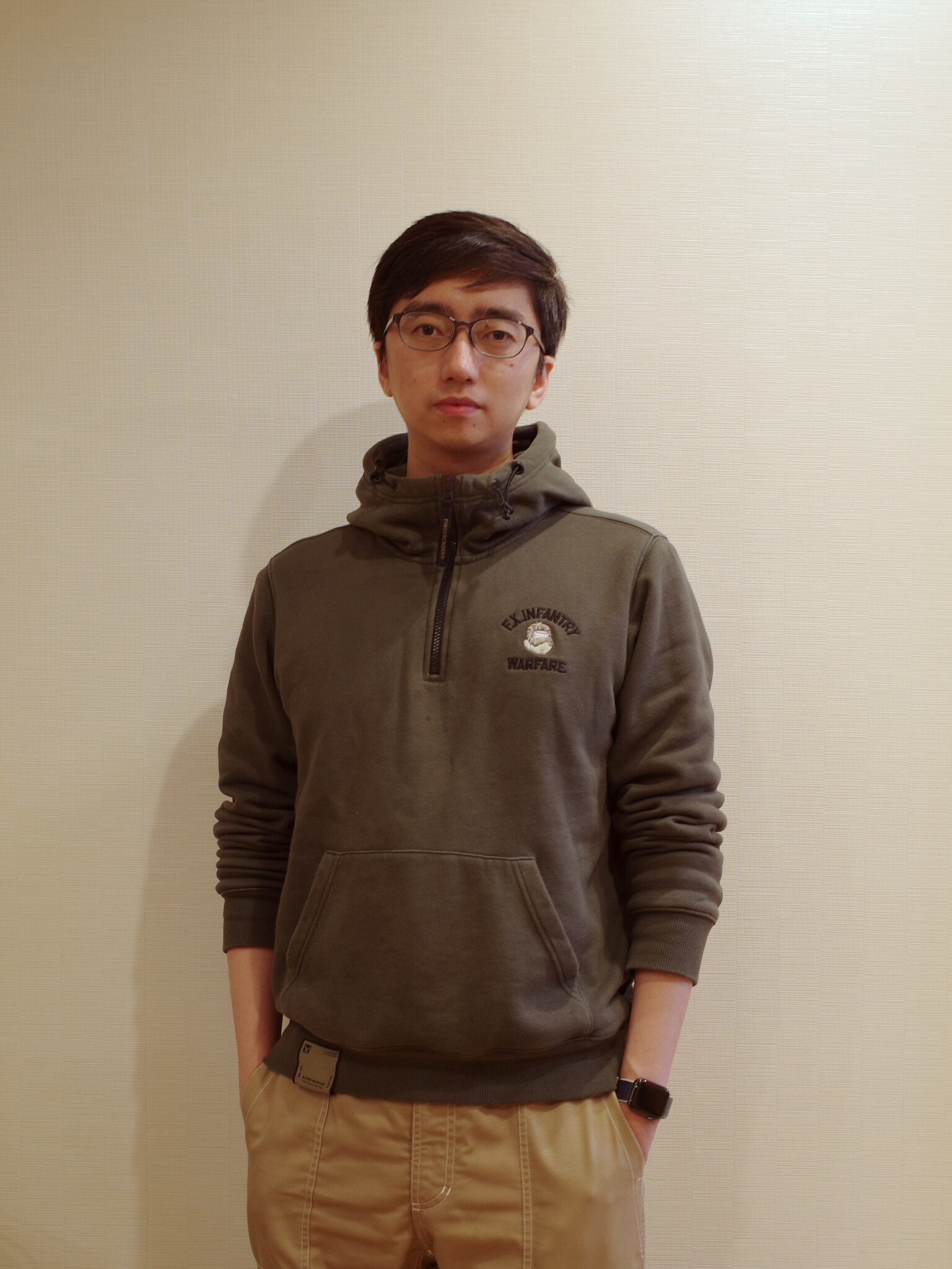
Luo Jiezhi, Assistant Art Director, Virtuos Shanghai

We spoke to him about his experience at Virtuos Shanghai and heard more about how he helps cultivate young artists into great industry professionals.

Tell me more about your career history at Virtuos and how you came to join us back in 2012.

After graduating from college in 2011, I started working at a different game company. However, at the time, I had already heard about Virtuos and the AAA games that it was working on, which included some of my favorite ones. When I was offered the chance to work at Virtuos as a junior artist, I jumped at the opportunity without hesitation, and the rest is history. I’ve been at Virtuos for 10 years, and I’m delighted to have worked on so many famous titles, including Horizon Zero Dawn, Horizon Forbidden West, and Shadow of the Tomb Raider.What sparked your interest in game art and design and motivated you to pursue it as a career? When I was a young kid back in 1993, my dad bought me my first console as he thought that it was important for children to learn more about new technology. That opened my eyes to the world of games and since then, I’ve been hopelessly hooked on it. As I grew older, I started playing AAA games such as Zelda and God of War, and I was fascinated by their game graphics and visuals. I believe that’s when my dream to become a game artist started.

Could you tell us more about what you do as an assistant art director?

As an assistant art director, I guide our teams’ art direction, project quality, and monitor progress to ensure we can deliver high-quality work on time. Before starting on a new project, I would study and understand the artistic requirements of the project, then translate them for my team members in a way that they can understand well.
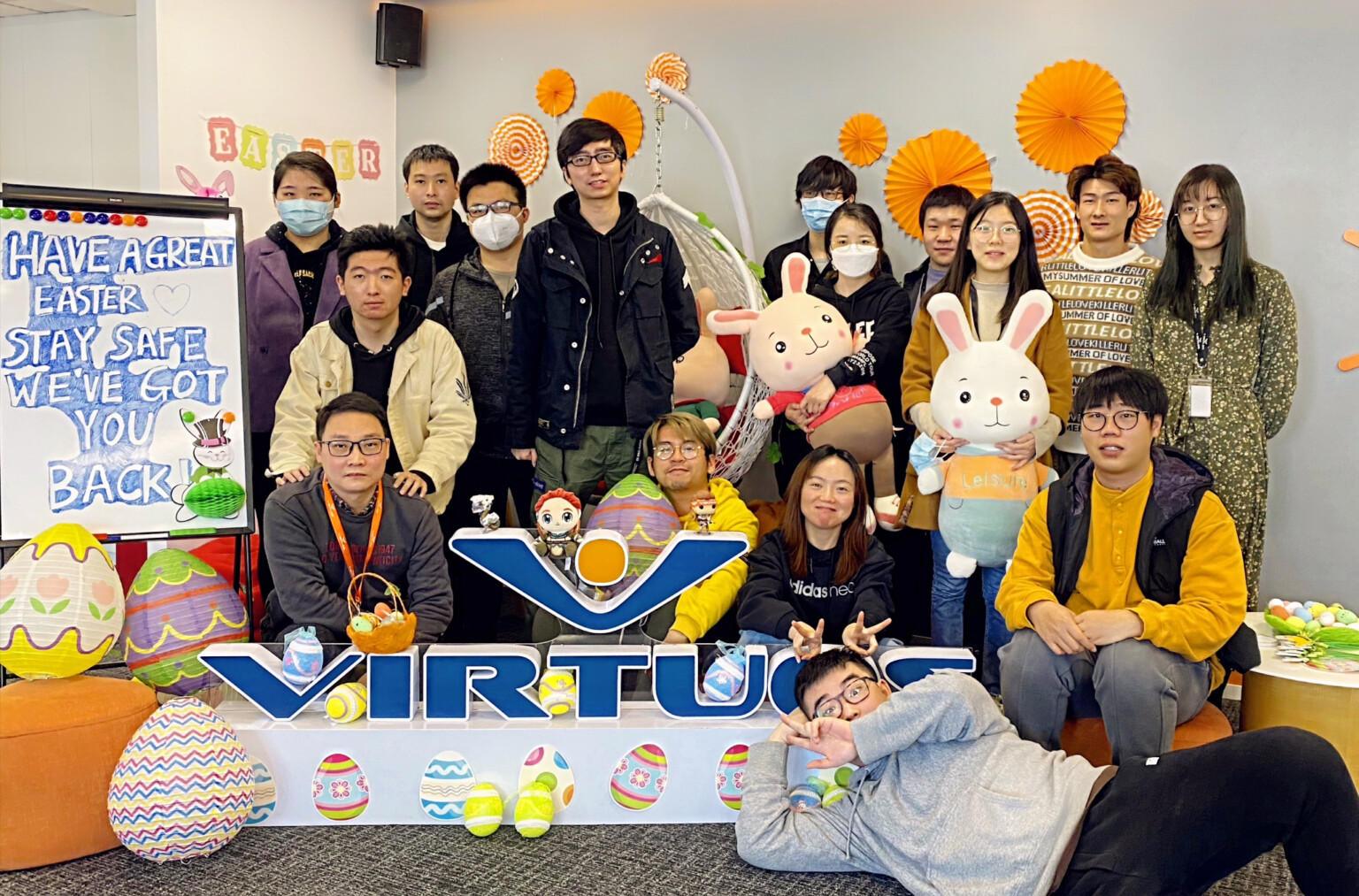
Jiezhi and his team in Shanghai

I also organize training for my art teams during the project process to ensure that the tools and methods we use are ahead of the curve. Besides training support, I provide my team members development plans that guide them to their ideal career paths and achieve their goals. Along with other senior art directors, I help to develop teams with unique characteristics that can synergize and work together to make games better, together.

What is the most memorable project that you’ve worked on at Virtuos?

That would have to be Horizon Zero Dawn. Back when I was a senior artist, we were tasked with creating the robots in the game. That was my first opportunity to work on such a big and complex project, and I was deeply impressed by Guerrilla Games’ movie-like design and art quality. While working on this project, I learned several techniques, including how to sculpt hard-surface models well using ZBrush. Besides technical skills, I truly realized the importance of pursuing excellence in whatever I do after seeing how amazing the final product of the game looked.

As a senior member of the art department, you work with junior artists regularly. How do you mentor and cultivate young artists and junior colleagues to become leaders themselves?

I try to loop our junior artists into projects as early as possible. In the early stages, I take the time to explain details, recommend techniques, and share my personal experiences with them. As they improve their skills, I will start assigning more complex tasks to help them to gain experience. While monitoring their progress, I usually provide them with some customized training tailored to their observed areas of improvement.

I also encourage them to improve their communication skills and find solutions to the problems they encounter by discussing with other artists in the team.

Through communicating with other team members, they learn to work better with people and gain the confidence to solve problems with their own ability, rather than to only rely on their seniors for solutions.My goal when mentoring junior artists is to encourage them to learn skills and accumulate experience independently.

Did you have someone who guided you throughout this decade at Virtuos, from a senior 3D artist to a team leader, and now, an assistant art director? Could you describe your learning process?

I think a lot of people have provided me with help and guidance in my journey, from my direct manager to senior members of the art department and Virtuos’ senior management. They’ve created a conducive environment for me to grow as an artist and leader, allowing me to take on more challenging projects over time. They’ve also been very responsive and accommodating to issues I’ve faced at work at times, communicating with me regularly.

At Virtuos, we have structured training support to help improve our technical skills and managerial abilities. Additionally, our Central Technology Group (CTG) often invites industry leaders and R&D experts to conduct lectures, giving us insight into the latest tools in game development to stay relevant.

We are also provided with certified training courses for professional managerial training. Besides such programs, Gilles, our CEO at Virtuos, also personally organizes internal sessions with us to share his management experience with us every year.

As a person and leader, I’ve learned to be more introspective and level-headed over time. When I was first promoted to a team leader, my seniors and mentor often reminded me to stay rational, think about problems from multiple perspectives, and make objective and reasonable decisions.

What are the three most important skills or traits that new artists should possess? What do you emphasize when teaching new artists?

There are three things that I usually advise new artists on – build a solid foundation of technical skills, have a strong and healthy mindset capable of overcoming challenges and hurdles, and possess a continued passion for games.

Basic skillsets are the fundamentals to achieving their dreams, which will carry them a long way as they progress further.

Furthermore, our projects at Virtuos are mostly AAA games that can be complex and challenging at times. An artist with a healthy mindset would be able to analyze problems with a rational mind and actively seek help rather than give up. Last but not least, our passion for games will help drive our careers in the video games industry and keep us motivated.

Tell us a bit more about yourself – what do you normally do on weekends and in your free time? Do you have a favorite game?

I enjoy playing basketball and taking walks along the Huangpu River with my wife during weekends and in my free time. Sometimes, I work on my personal game-related projects, and of course, playing games is an essential part of my life too! I’ve tried many games but my favorite is still the Zelda franchise, which has some of the best games that have ever been made, hands down.

Share with us a piece of advice that you’d give to your younger self and other young artists starting out in the video game industry.

Never fear challenges; trust your abilities, and your efforts will definitely pay off.
EXPLORE A CAREER WITH US AT VIRTUOS

Expert Talks: How Original Anime-Style Characters Are Created, As Explained By Virtuos Artists

General / 19 May 2022

This article is part of an editorial series of Expert Talks by Virtuos aimed at sharing the learnings and best practices in global game development and art production. In this installment, Chen, Lead Artist, and Jing, Senior Artist at Virtuos Chengdu take us through the process of creating original anime-style characters for a recent ACG Jam contest.

Anime art is a uniquely stylized form of two- and three-dimensional illustration and animation that originated in Japan in the early 1900s. Officially recognized by the Japanese Ministry of Education as one of the most important forms of artistic expression in modern Japanese culture in 2000, anime-style art has been highly popularized internationally in the form of films, animation and games. The art genre has also evolved over the years, with more realistic character designs and richer animation with each generation improving upon previous works.

While anime art may seem easy to the unknowing, an artist’s solid fundamental skills are essential when it comes to drawing high-quality anime art, despite how simplistic it may seem. To start off, the artist must possess a strong understanding of basic anatomy to draw believable characters, and have a good sense of perspective when drawing characters and backgrounds in order to create the illusion of a 3D object on a 2D surface. Besides anatomy and perspective, a good grasp of color theory concepts such as saturation, values and contrasts are also key to creating a visually pleasing and interesting anime art piece.

To give our artists an opportunity to explore and design various forms of anime-style character art outside of their regular projects, our team at Virtuos Chengdu organized an Animation, Comics and Games (ACG) Jam design contest for them to flex their creative skills.

The Design Brief

  • Participants can choose from three different submission categories – character illustration, character concept art, and illustration. They can submit to more than one category.
  • Artists should participate and send in their submissions individually.
  • Only original submissions are allowed.

“While the organizers were formulating the topic of this competition, we deliberately chose a style that has been rarely covered in the teams’ usual projects. The purpose of this ACG Jam is to explore the potential and hidden skills of our artists, and we are glad to see that everyone was able to showcase their versatility in art styles through the contest,” said Liu, one of the art directors on the judging panel.

“Besides our artists from the Concept Art department, colleagues from the 3D Character and Technical Art teams also took part in this contest and submitted unexpectedly impressive sketches, showing their artistic skills outside of their expertise.”

In this Expert Talks installment, we spoke to two of our winning artists in ACG Jam to learn more about how to create original anime-inspired characters.

CHEN: DRAWING INSPIRATION FROM FAVORITE BOOK TO CREATE ORIGINAL CHARACTERS

Chen, Lead Artist, Virtuos Chengdu

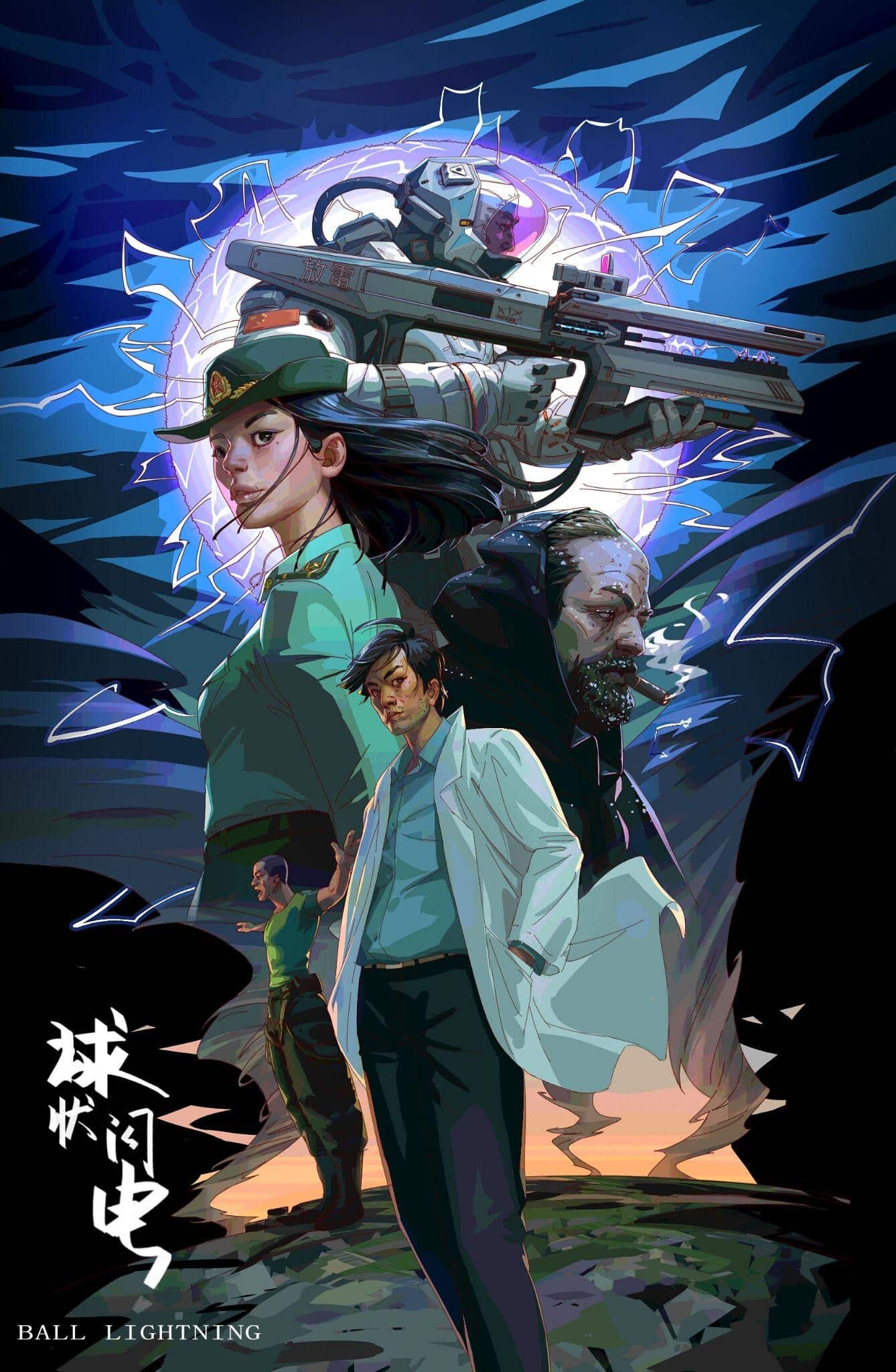
We spoke to Chen, the lead artist at Virtuos Chengdu who won the Most Popular Award in the ACG Jam with his submission titled “Ball Lightning”. The “Most Popular” award was determined based on internal voting by Virtuos employees.

“Ball Lightning” by Chen

Hi Chen, congratulations on winning the “Most Popular” award! Could you share with us about how you came up with the concept of “Ball Lightning”?

Chen: Thank you! Actually, this piece is named after “Ball Lightning”, a novel by the Chinese author Liu Cixin. I’ve been inspired by this novel on many occasions and I’ve drawn some sketches based on the story in my spare time. The story content has many interesting points and has brought me an endless stream of imagination.

When I decided to draw a sketch based on “Ball Lightning” for ACG Jam, I thought to myself, “How can a simple image depict the entirety of Liu’s novel?” It was just too difficult to work out. Eventually, I decided to design a book cover inspired by the story to express my admiration for it, portraying all the main characters of the story in the cover.

Is this your first time working with anime-style art?

Chen: I’ve experimented with anime-style art in the past, designing male and female characters for a project a few years ago. Back then, I wasn’t sure if I had completely grasped the concept behind anime-style art but simply thought that it was pretty fun. This was a good learning experience.

Overall, this looks like a movie poster design or a book cover! How did you come up with the various elements (e.g. the characters and colors) and arrangement of this piece?

Chen: For the characters, I designed them based on how the author described his main characters, such as their features, attires, and ethnicity. The five characters featured in the piece are Dr. Chen, Navy Colonel Jiang Xingchen, Female Major Lin Yun, physicist Alexander Gmov, and a soldier equipped with a ball-lightning weapon.

While designing the ball lightning mentioned in the novel, I used some stylized methods to depict my own rendition of the ball lightning while drawing reference from real-life examples, since the phenomenon has actually occurred in reality. Based on my understanding of ball lightning phenomena, the occurrence of lightning is closely related to the climate, so I used cool blue tones as the base color of the artwork, but added some warm tones of dawn to reflect a glimmer of hope in the final piece.

One of Chen’s rough drafts of “Ball Lightning”

How long did it take you to sketch and color the entire piece, and what are some tools that you used to create “Ball Lightning”?

It took me around a week in total during my spare time to finish the piece. I did most of the sketching on an iPad, and moved to Photoshop for the line art and coloring.

If this project was expanded and made into something bigger with the help of other team members, what would you want to do to enhance this art piece?

If this project was expanded, I’d like to make individual art pieces for all the characters so that I can amplify each of their different character attributes and characteristics, and make them look more unique.

For example, Major Lin Yun is a soldier with a stoic, resolute character, and will do anything to achieve her goal, even to the extent of sacrificing herself. Her character and personality is more befitting of a beautiful, cold, behind-the-scenes military leader with a tragic past.

JING: BUILDING AN IMAGINARY WORLD TO INSPIRE AND CREATE ORIGINAL CHARACTERS

Jing, Senior Artist, Virtuos Chengdu

Besides Chen, a handful of artists also received accolades for their impressive submissions. One of them is Jing, a senior artist at Virtuos Chengdu, who submitted three vividly-drawn character sketches, bagging him the “Biggest Head-turner” award for this contest. We spoke to Jing to learn more about how he created his anime-inspired characters.

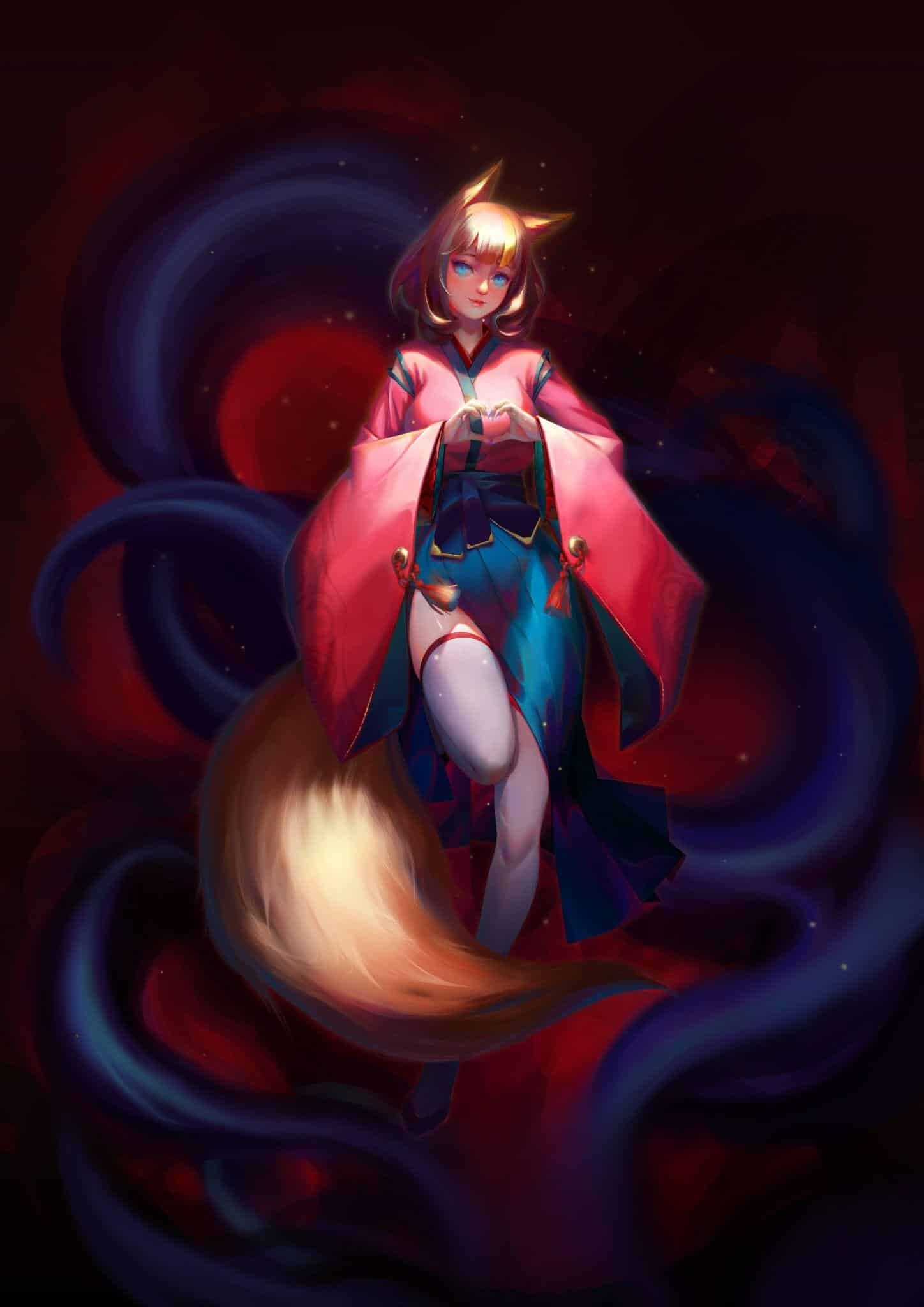
“Fox Lady” by Jing

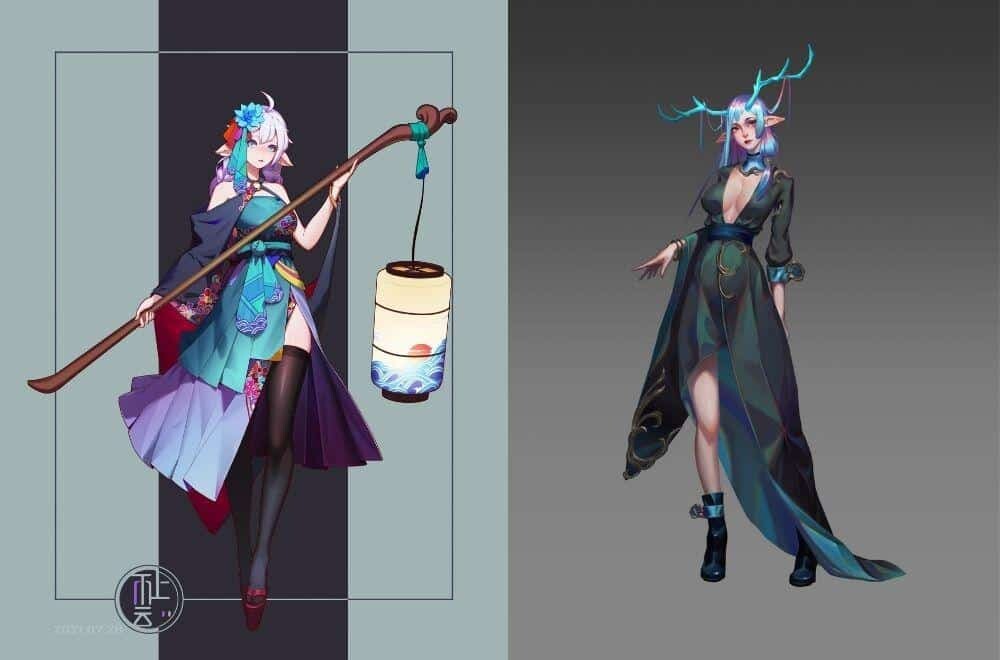
“Lantern Goblin” (left) and “Deer Nymph” (right) by Jing

Hi Jing, congratulations on winning the “Biggest Head-Turner Award” for this contest! Could you share more about how you came up with the concept behind these art pieces, and your inspiration behind them?

Jing: Thanks! A significant part of my inspiration comes from artworks such as Onmyoji and Demon Slayer, which are two of many narrative settings that drove me to create my own stories and characters. While planning my pieces for ACG Jam, I came up with an imaginary world for my characters in which humans and demons lived together.

Is there a story behind the three characters that you designed?

Jing: When I create characters, I want to invoke curiosity in my viewers to wonder about who my characters are and what their backstory is. My three characters, “Fox Lady”, “Lantern Goblin”, and “Deer Nymph” originate from the same world. I imagine them to be otherworldly creatures such as fox spirits, goblins and nymphs living on the same continent, living their own lives, with their own stories. I designed each of them with slightly different styles as I wanted to experiment and try out more art styles to figure out which I preferred.

What was your thought process when designing the characters’ style, color arrangement and fashion choice?

Jing: During the concept sketching process, I spent some time imagining their personalities, living conditions and other environmental factors. Afterwards, I collected some similar reference materials, using them to piece together the image that I want in my mind.

For example, “Fox Lady” is a character based on a kitsune, also known as a fox spirit in Japanese. In Asian folklore, fox spirits are usually depicted as mischievous, full of trickery, and have the ability to disguise themselves as attractive beings. The character I drew was thus designed to be very beautiful and eye-catching, yet mysterious at the same time. Thus, I used several dark tones in the background to create a mysterious look, and dressed my character in feminine-looking and Asian-style clothes.

How long did it take to draw all three pieces, and what were some of the tools you used to sketch them?

Jing: It took me roughly 30 hours (in multiple sittings during my free time) to create each piece, so around 90 hours in total. I mainly drew them using Photoshop.

If this project was expanded and made into something bigger with the help of other team members, what would you want to do to enhance this art piece?

Jing: I’d definitely want to spend more time on world building and developing each character’s backstory further. If I had more time, I would like to create more interesting characters as well.

GIVING ARTISTS AN AVENUE TO EXPLORE LATENT ABILITIES

At Virtuos, we are committed to creating opportunities for our game creators to continuously learn and grow in various ways, through hosting art and game jams and providing structured and on-the-job training to aid their professional development.

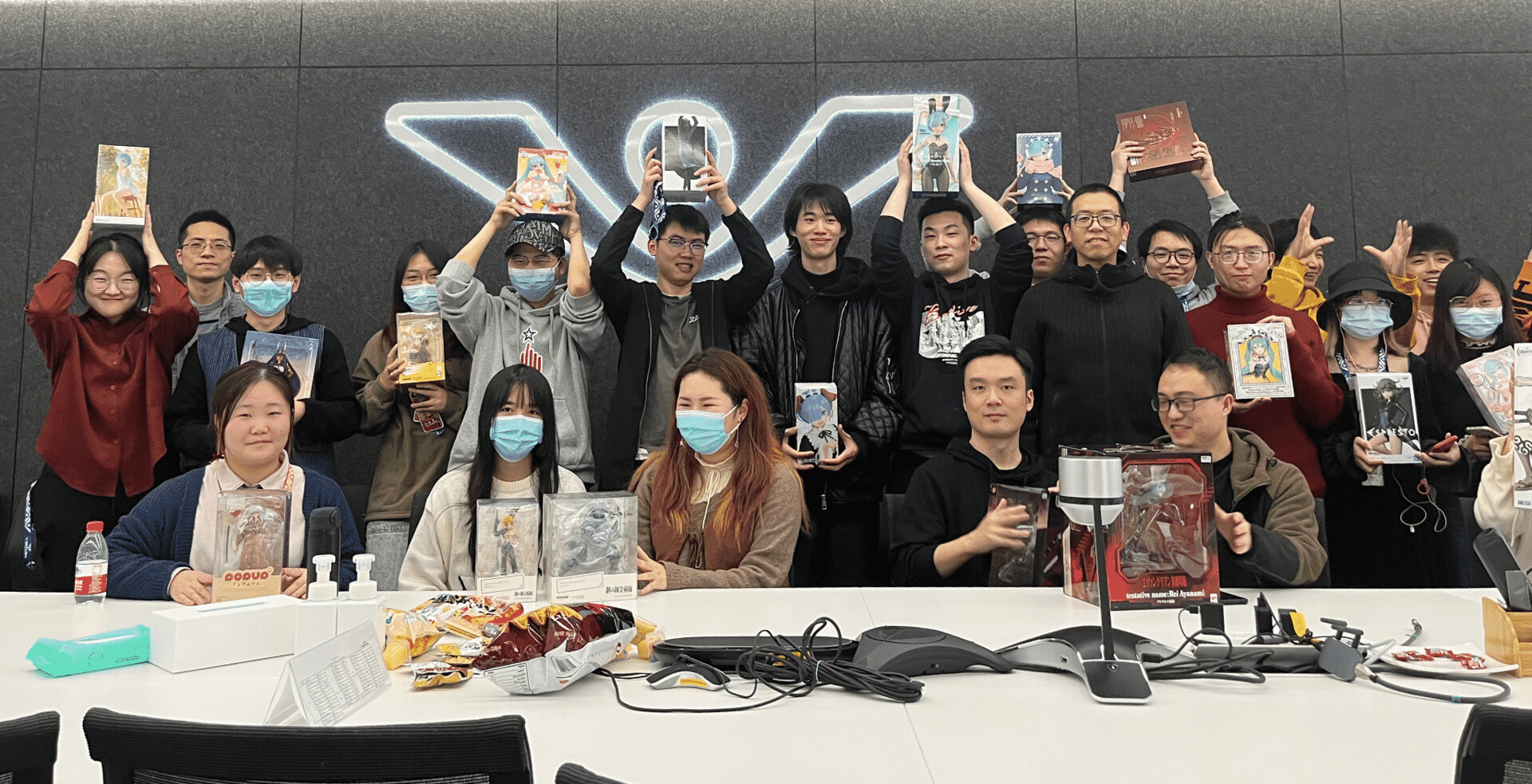
Post-contest celebration in Virtuos Chengdu

Through internal activities such as our art jams, our artists not only have the opportunity to test their own abilities but also learn from each other and encourage their fellow teammates to further hone their craft.

“Besides promoting healthy competition, the great thing about having such contests is giving our artists a platform to flex their creative muscles outside project boundaries,” said Chan, our Art Studio Director at Virtuos Chengdu. This gives our artists an avenue to unleash their latent abilities which could otherwise stay unexplored.”

EXPLORE A CAREER WITH US AT VIRTUOS

Expert Talks: How To Create And Develop A Concept Art Piece From Scratch

General / 28 April 2022

Concept art is the starting point where ideas become reality, and concept artists are responsible for the fundamental creation of a wide range of ideas, from tiny props and accessories to full characters and large environment concepts.

As concept artists, we help modelers, visual effects (VFX) teams and animators in our global studios visualize art project ideas to be developed for production,” shared Jessica Taylor, one of our artists at Virtuos Montreal.

Jessica Taylor, Concept Artist, Virtuos Montreal

WORKING AS A CONCEPT ARTIST IN VIRTUOS MONTREAL

Like many artists at Virtuos, Jessica shared that her love for drawing bloomed at a young age and has since sustained till today. As a concept artist with an academic background in graphic design and architecture, Jessica revealed that she made the switch to concept art. She wanted to find a way to combine what she learned in university and her interest to draw characters and experiment with fun ideas.

At Virtuos Montreal, Jessica works on both environment and character concept art. “It’s refreshing to work on both, as it allows me to be consistently engaged in the projects I’m working on, instead of feeling burnt out from doing strictly only one type of work. Also, it’s fun getting to work on both environment and character work and grow my skills in both aspects.” She added that the content she learned in graphic design and architecture has been very applicable to her profession as a concept artist, especially in being able to take an idea and apply it consistently throughout a design.

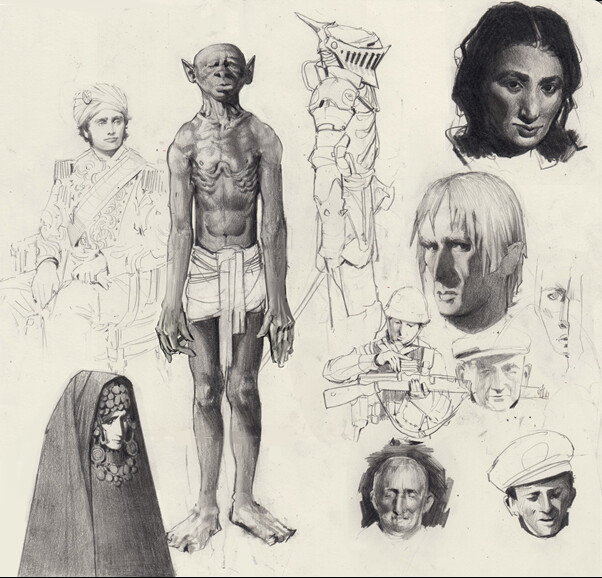
Personal Concept Art Sketches and Projects

As a concept artist, it’s important to keep an open mind and learn to appreciate different styles that other artists have.

”It’s also a good practice to draw outside of work and do some exploring on your own – just a couple of sketches a week or a few doodles here and there helps,” Jessica advised.

To improve her skills and experiment with different styles, Jessica consistently works on personal projects in her free time, some of which can be found on her ArtStation profile:

Image courtesy of Jessica Taylor

Besides sharing her sketches and projects, Jessica also occasionally uploads video tutorials for her art content on social media. Check out one of her YouTube videos here:

DRAWING A CONCEPT ART PIECE FROM SCRATCH

During our interview with Jessica, we delved into two of her personal projects on ArtStation. We learned how she came up with the ideas and developed them into complete, original creations.

1. CREATING CONCEPT ART USING REAL-LIFE REFERENCES: BRIDGE BETWEEN THE TWO ROOTS

Showing us one of her personal works, Jessica shared that the outdoors is a great place to garner ideas and inspiration for environment-themed concept art projects.

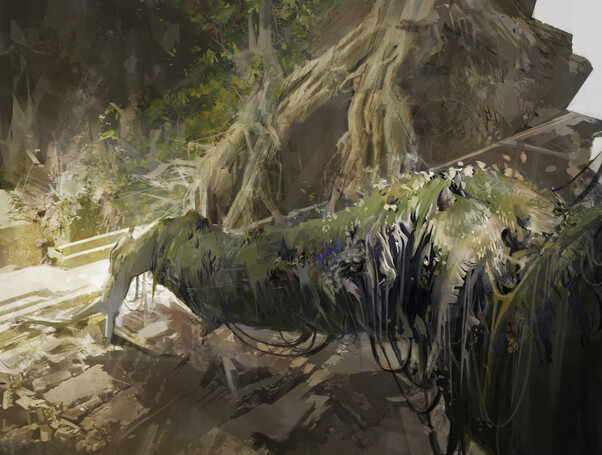
Bridge Between the Two Rocks

Jessica revealed that the piece above named “Bridge Between the Two Roots” was based on a moss-covered branch that she found just outside her house.

The branch found outside Jessica’s house

I started with reference photos that I took of the stick. I particularly liked the moss and fungi growing on the branch,” she added.

After gathering reference material, she began with a simple sketch and outlined the idea behind the piece.

Step 1: A simple sketch/outline

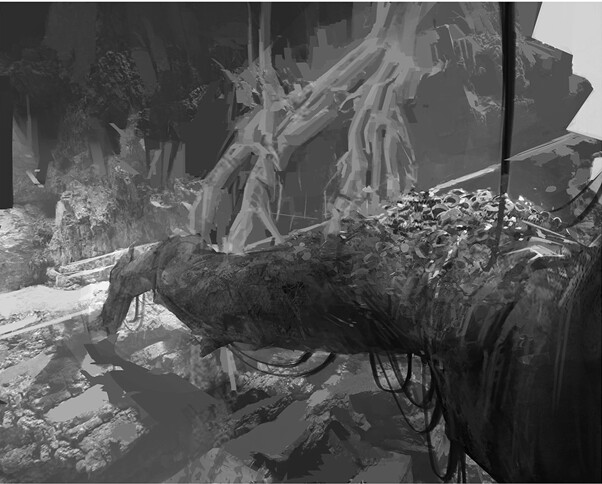
Next, she added values to the sketch to create dark and light contrasts in the details and later coloring.

Step 2: Adding values

Afterwards, Jessica overlayed the photos of the branch onto the value sketch (as shown in Step 2) and started building the details on Photoshop, creating a realistic yet mystical look.

Step 3: Building Details on Photoshop

After the initial details had been filled in, Jessica chose the color palette after preparing both a warm and cool option with eight shades each. “After adding the colors, I could really see the sketch coming together. I went with the warmer shade in the end as the cooler palette seemed a bit stale to me, so it was just a matter of personal preference,” she shared.

Step 4: Coloring

After adding the colors, she continued to add more detail and touch-ups before finally completing “Bridge Between the Two Rocks”.

Completed “Bridge Between the Two Rocks”

This particular sketch was a very fruitful exercise in creating something new by combining my ideas with real-life references,” said Jessica.

2. CREATING CONCEPT ART OUT OF A STORY: FLOATING QUARRY ISLE

Besides collecting ideas from physical environments and items, Jessica shared that she enjoys drawing ideas from fictional stories and her imagination. She experimented with creating an ethereal “floating quarry isle” in a personal challenge she set for herself.

In the concept narrative that Jessica developed, a young knight on an adventure has been tasked with a mission to forge a sword out of a special stone found on a floating quarry in the middle of the ocean to carry on with his adventure.

For the idea to work, Jessica shared that it was essential to plan and research thoroughly:

  • How would the knight be able to travel to the quarry?
  • How would he get onto the floating quarry?
  • How would he forge the sword after collecting the materials?

While researching, Jessica drew references from outdoor adventure activities such as rock climbing to enrich her ideas, adding climbing cables and suspended ladders on the floating quarries which the knight could interact with.

Research material for the floating quarry isle

Jessica started her concept sketch with a rough outline of the floating quarry isle, forming a base island with a dock for sailboats and a cluster of cuboid rocks floating above it.

Ideation and sketching

To find the ideal combination that fit the narrative of her story, she crafted multiple sketches to test and experiment with.


Concept Sketches by Jessica

After testing with multiple sketches and filling in the details, Jessica shared her final design of her floating quarry isle:

Final look of the Floating Quarry Isle

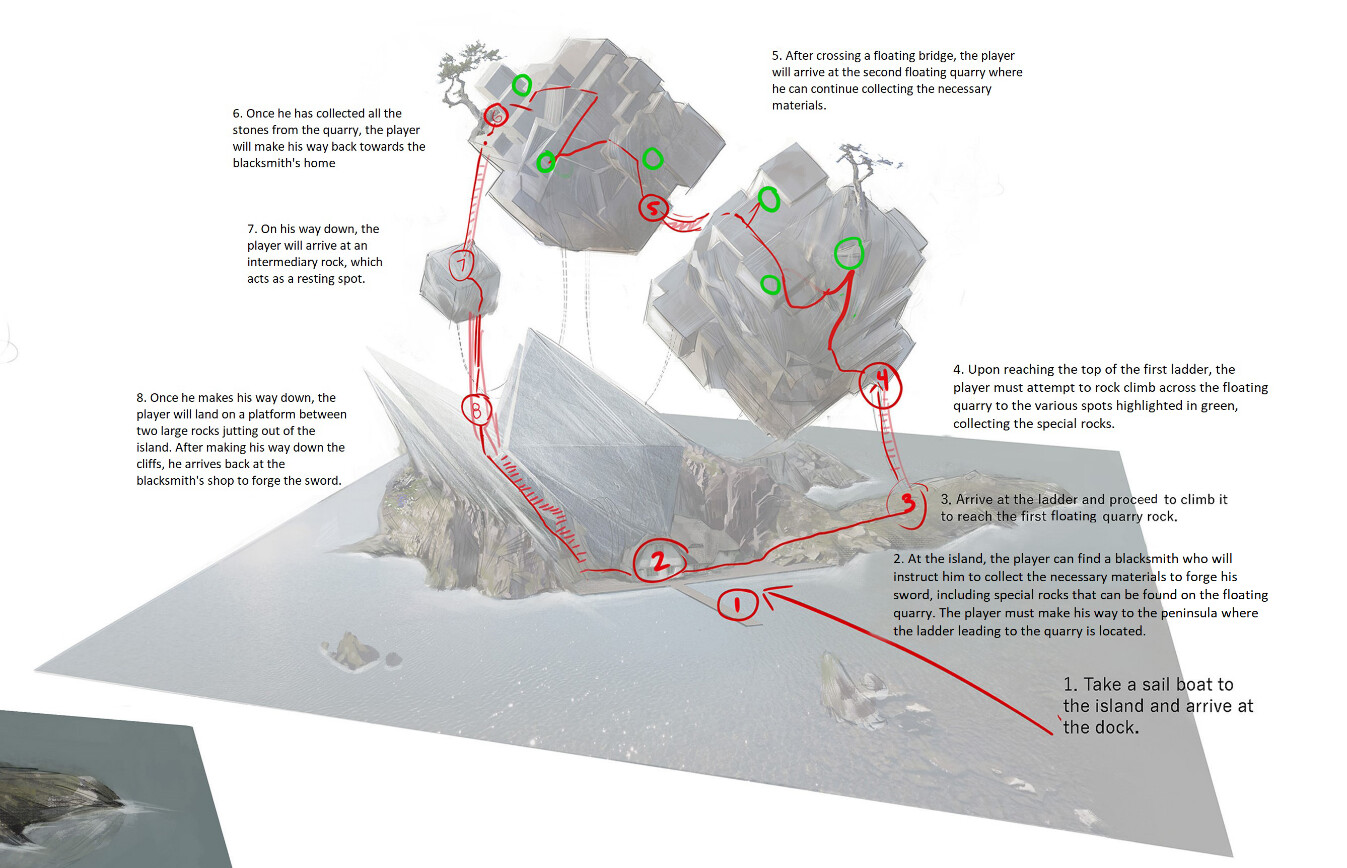
In the final design, Jessica detailed the setting and narrative of the knight’s adventure at the floating quarry isle from start to end:

  1. First, the young knight takes a sailboat and arrives at the island’s dock.
  2. The knight finds a blacksmith/stonemason living on the island. After listening to the knight’s request, he instructs the knight to make his way to the peninsula, where he will find a suspended ladder that leads to the first floating quarry where the first stone can be found.
  3. The knight embarks on his mission to collect the various stones on the floating quarries, climbing up the ladder to ascend to the first floating quarry.
  4. At the first floating quarry, the knight begins to rock climb across the tricky terrain to obtain the materials he needs.
  5. After collecting the first stone, the knight crosses a floating bridge to arrive at the second floating quarry, where he finds the rest of the materials he needs.
  6. Once he’s done collecting his stones, the knight makes his way down from the second quarry using another suspended ladder.
  7. He arrives on an intermediary floating rock on his way down, where he can take a short break.
  8. The knight then lands in a valley formed by two large, sharp stones jutting out of the island. He makes his way further down the cliffs via steps, back to the blacksmith/stonemason’s shop, where he hands in the materials to forge the sword and completes his mission successfully.

Narrative for the knight and the floating quarry isle

This project was mostly an experiment for me to try and push an idea as far as I could, and I really enjoyed the whole process. It was very satisfying rendering the final artwork,” Jessica shared.

ADVICE FOR NEW CONCEPT ARTISTS

Stressing again the importance of keeping an open mind, Jessica highlighted that taking a wide range of projects is a great way to learn and improve as a new concept artist. “Don’t limit yourself by taking on only one type of task. Trying your hand at environments or prop design projects could end up helping you design better characters, vice versa,” she said.

At Virtuos Montreal, the team regularly conducts critique sessions to toss different ideas around, Jessica mentioned, adding that such sessions enable them to pick up new tips and learn from one another. “None of the critiques is personal. We’re all trying to improve our skills and produce the best work we can, so we enjoy the process and take the comments objectively,” further sharing how the group sessions have helped her grow as an artist.

It’s a great opportunity being able to work alongside passionate artists with a variety of strengths at Virtuos Montreal. Being immersed in such an environment has allowed me to develop myself as a concept artist, especially when working with a team with an awesome attitude,” Jessica said.

If you’re looking to work in an exciting environment that encourages your personal artistic growth, Virtuos Montreal is definitely the place to be!

EXPLORE A CAREER WITH US AT VIRTUOS


Virtuos Insider: Trong Hoan On Fusing Technology And Art

Article / 13 September 2021

If the game industry were to resemble a game of Dungeons and Dragons, the role of a Technical Artist would undoubtedly translate into a hybrid class. These talented individuals possess both the ability and creativity to sculpt and illustrate, as well as the technical expertise to create complicated software tools to aid their fellow artists in their work.

As a studio dedicated to producing digital entertainment based on some of the most renowned IPs in the world, Sparx* – one of several studios within the Virtuos Group – prides itself on retaining highly talented and motivated individuals to get the job done. Not only must one possess the skill to excel, they should also exhibit at least a silver of interest in games and film to truly feel at home.

In Trong Hoan’s case, that was no problem at all. Hoan spent his childhood days perfecting his skill with gaming classics, while cultivating an interest in art and technology. It’s paid off quite handsomely – these days, he’s an expert in anything from animation and rigging to crafting developer tools.

Check out the interview below to learn more about Hoan and what being a Technical Artist truly entails.


What were you working on before joining us at Sparx*?

Before working at Sparx* I was a Technical Artist at a small VFX house in Ho Chi Minh City, in Vietnam. I have also been an independent instructor, primarily of Artistic Anatomy, and of Rigging, Python Scripting and Digital Figurative Sculpting. Prior to my career, I studied abroad in the United States for 7 years.

Which project in your time at Sparx* was the most memorable one to you?

The most memorable project was a full-pipeline test I participated in, where I could see every department at Sparx – Modeling, Rigging, Layout, Animation, Lighting, FX, Compositing – come together to produce a finished sequence. I was very happy to witness how every team’s contribution fit into a greater whole.

What’s the proudest moment of your career so far?

I’ve had the opportunity to work on a lot of exciting AAA projects at Sparx*, which has been a fantastic chance to grow. Personally the highlights of my career were the moments when I managed to gradually produce tools of higher complexity that artists actually use daily, and feeling somehow that the ‘dots’ I had been putting down throughout the years are now starting to connect with each other. It’s been a truly amazing journey so far.

Could you explain a little about what Technical Artists like you actually do?

The shortest summary would be that a Technical Artist is usually expected to wear many hats. Troubleshooting technical issues for artists, working with ITs to set up equipment for new projects, writing tools to speed up workflows, foreseeing potential technical pitfalls, researching solutions to problems, writing technical documents to spread best practices, reading technical documents, undergoing training for new tools/software… these are just some of the things that we do.

What’s the best thing about being a Technical Artist at Sparx*?

To me it’s having the opportunity to work alongside my peers – other Technical Artists and Technical Directors, especially when they are far better than me in terms of technical experience and knowledge. I wake up every day feeling very inspired knowing that there are still plenty of new things to learn.

What’s a normal work day like for you?

It can vary a bit depending on our current projects. Some days I’d do some Rigging works, or provide some advice on Human/Animal Anatomy. My normal work day however has increasingly gravitated around coding – writing tools and fixing bugs – over the past years.

Do you think that artistic skills are more important than technical skills for Technical Artists, or vice versa?

Since the scope and definition of what counts as ‘Technical Art’ can be quite vast, the actual task at hand usually dictates whether the Technical Artist in charge should lean towards the artistic side or the technical side to achieve the best results. For example, aiding Character Artists to sculpt facial expressions that adhere to the Facial Action Coding System (FACS) would require more artistic vision, while providing helper tools for them to perform said task would require more technical input.

How important do you think research is when working as a Technical Artist?

I believe that research is not just an important step, but a vital one in keeping up with the industry’s pace. There’s also the constant demand to update and innovate within one’s field of expertise. However, I find that in order for research to be fruitful, a good foundational knowledge base is always required.

Tell us a bit about your personal life. How did you get exposed to technology and games?

I can still vividly recall a moment in summer 1998, when I gazed through a window at people at my elementary school having access to PCs, each using MS Paint to color in an image of the Statue of Liberty. I was mesmerized. Two years later my parents allowed me to attend a Pascal class filled with grown-ups who didn’t seem to want to be there. Those two instances must have been my first exposure to technology.

I eventually got carried away with drawing and all the things related to it, like Architecture, Animation and Fine Arts. Now, I’m finally back to dealing with technology again!

What sort of interests do you have?

I enjoy reading, and also doing small DIY projects for my living space.

What do you like to do to relax after work?

Foraging for good Internet memes! Besides that, as ironic as it sounds, I regularly pursue personal projects after work to avoid burnout. The things I dabble with can range from Artistic Anatomy sketches and studies, to some minor software tools that I would write for fun. I believe that these personal projects help keep me sharp and would eventually feed back into my professional work in many ways.

Do you have a favorite game, or a genre of games?

My junior high school years were about 20 years ago, which I spent living in a rural town in Vietnam. My buddies and I would completely lose our minds back then with games like Age of Empires I, Warcraft 2, and Counter-Strike. I wouldn’t be offended if someone were to call me sentimental; those are some of the fondest memories that I still hold dear today. Outside of video games, I also remember making simple toys by chopping bamboo and using rubber bands to make little catapults to play with my younger brother.

Is there anything you would like to say to anyone reading up about Sparx*?

Come join the Sparx* side! We can’t always reveal what we’re working on at any moment due to the NDAs and secrecy surrounding our projects, so what we do might not always be too clear for someone looking in. But the mere fact that we’re being so careful about what we’re working on should be proof enough that we’re always working on something exciting at the studio.

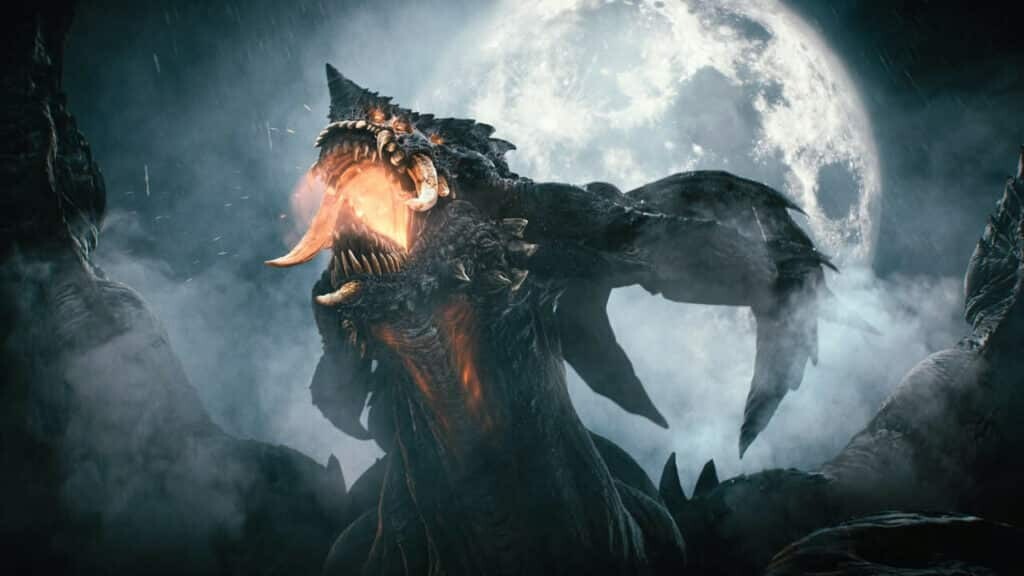
The Return Of A Classic: Demon’s Souls Remake Released On Sony Playstation 5, Featuring Virtuos’ Contribution

Making Of / 13 September 2021

The official release of PlayStation 5 from Sony has also welcomed the return of the classic Demon’s Souls, the beginning of the renowned Souls series.

Entirely rebuilt and masterfully enhanced to breathe new life into a decade-old title through an astonishing 4K cinematic, the remake of an all-time classic –Demon’s Souls awaits its chosen warrior.

Having tackled a couple of remasters before, with this title our member studio Sparx* in Vietnam was indeed taking on a real challenge to combine our end-to-end expertise in both art and technical abilities and go out in their cinematics production pipeline. That includes crafty works in plenty of heavy up-res assets and realistic animations, alongside dressing vast, sweeping landscapes by multilayered atmospheric effects and large-scale destructions.


By finding the right mix of procedural tools to achieve top-notch simulations and effects, together with previous experiences from other high-end remasters, our artists and animators at Sparx*, together with the team at Sony, have successfully choreographed epic combats and orchestrated titanic battles to satisfy the decade-long wait.

Many thanks to Sony Interactive Entertainment for featuring us in such a multi-disciplines production process for the rebirth of this cult classic. Demon’s Souls is now available on PlayStation 4 and PlayStation 5. Venture into the depth of a dark fantasy world and follow us to keep up with future announcements!

• For more news about Virtuos, please visit www.virtuosgames.com/en/news 

• For business inquiries, please contact marketing@virtuosgames.com

ABOUT SONY INTERACTIVE ENTERTAINMENT

Recognized as a global leader in interactive and digital entertainment, Sony Interactive Entertainment (SIE) is responsible for the PlayStation® brand and family of products and services. PlayStation has delivered innovation to the market since the launch of the original PlayStation in Japan in 1994. Headquartered in San Mateo, California, SIE is a wholly-owned subsidiary of Sony Corporation and has global functions in California, London, and Tokyo. For more information, please visit www.sie.com

Virtuos Experts Talks #11: Harnessing Photogrammetry and Creating Virtual Worlds at Sparx*-A Virtuos Studio

General / 01 September 2021

The eleventh in a series of regular articles highlighting learnings and best practices from Virtuos' global development, Art, and VFX teams.

Introduction

As PC and console hardware continues to improve, games are able to render increasingly higher poly-count meshes and higher resolution textures in game engines, thus allowing game designers to create ever more realistic environments in AAA titles. However, the process of creating these ultra-quality game assets has similarly increased in time and complexity, especially if the goal is to make them as lifelike as possible.

In hindsight, the pivot to photogrammetry is almost a logical progression, due in part to increased demand for ultra-realistic in-game assets and the continuous evolution of game engines. Now, anyone can take a series of photos, process them and produce an extremely realistic-looking model with matching textures in the span of just hours to a few days’ time, ready for use as a game asset.

Photogrammetry has been around for many years, but it wasn’t until it was publicized as a success story in the making of Star Wars Battlefront at the Game Developers Conference (GDC) four years ago, that more and more developers have begun looking into it as their next tool in their arsenal. Virtuos has similarly made progress with photogrammetry within its various studios and is currently using the technology to produce highly detailed environments in various end-to-end game production projects.

The Inception of Photogrammetry at Sparx*

A significant part of Virtuos’ photogrammetry activity is performed at Sparx* – a Virtuos studio located in Ho Chi Minh City, Vietnam. Known for its visual effects work in major blockbuster films such as Star Wars, Sparx* possesses the talent and the necessary equipment to jumpstart our exploration of photogrammetry.

Although Sparx* had been using photogrammetry for film work for quite some time, it was mainly used as an accurate guide for modelling real-world objects; the actual model was created by hand afterward, with its textures re-projected from the photos taken of its real-life counterpart.

It wasn’t until late 2018 when the studio processed and de-lit data and then rebuilt entire locations in Unreal for the first time for Disney Plus’s “The Mandalorian”, that photogrammetry was seriously considered as a tool for creating realistic 3D objects efficiently. The years that followed saw Sparx* devote more time and resources to researching and testing the technology, simultaneously building up the process and acquiring the necessary hardware. At this moment, Sparx* is already using photogrammetry extensively on a number of yet-to-be-released game projects. Leading the charge are Kristian Pedlow, Senior Art Director, and Minh Son, Senior Technical Artist. They are members of the ‘Photogrammetry Strike Team’ at Sparx*, a team of staff responsible for all things photogrammetry within the studio.

Capturing Reality: How Sparx* Acquires Scans

Before heading out into the world to conduct photogrammetry scans, the Sparx* Photogrammetry Strike Team first assembles a collection of equipment necessary for the acquisition process:

  • A full-frame body camera (the team currently favors a Sony A7II)
  • A decent full-frame prime lens and zoom lens (28-70mm zoom lens are the present choice)
  • An X-rite Color Checker
  • A ring flashlight, to ensure the subject is properly lit
  • Light diffusers (to avoid the need to delight hotspots in photographs)
  • A foliage cutter
  • Flags to pin on objects when scouting and or Google Maps
  • Slates and a ruler for naming objects and scale cue
  • A handheld flashlight (for foliage)
  • Two orbs – in chrome and grey
  • Black-colored cloth for use when keying out objects (black works better than green or blue)

Minh Son: “A typical expedition will last from a few days to a week, depending on how large the landscape is and how many assets we want to acquire in the chosen biome.

We usually begin by spending up to a full day to scout the area that we chose, during which we would make a list of all the assets that we would need. Then we’ll spend the next few days systematically capturing all of them, making sure that we don’t miss out on anything.

Before the acquisition of each asset, whether indoors or outdoors, we would first take a photo of it with a Color Checker for white balance and color correction later. Another photo would then be taken with a rule to get an idea of the asset’s scale.”

Once the preliminary photos are taken, the capture can begin proper. There are three main categories of scans to capture in these expeditions: Assets, Surfaces, and Foliage/Atlas.

Assets

In the context of photogrammetry, Assets are real-world objects that are scanned and processed individually.

First, the Strike Team captures an overall view of the asset, to make sure that no part is missing when they proceed with image alignment, and to minimize the need for manual alignment. Next, the camera is moved up close against the asset to capture every single detail possible; a third-round may be required if the asset possesses some sharp corners that need focusing on.


Minh Son: “In cases where hard shadows appear like in the above example, we would try to capture with a polarization filter which may help in reducing the directional light intensity somewhat, although a delighting phase is still necessary later on in the process.

For proper capturing, we make sure to always move the camera between images. Panning or rotating the camera on a stationary tripod without moving it will sometimes cause duplicate geometry with a slight offset. I would also recommend avoiding camera groupings like the ones below:"

Surfaces

Environment surfaces are also acquired via photogrammetry when there’s a need to capture the surrounding landscape.

For surface acquisition, the team uses a tripod or monopod to attach the camera, ensuring that the camera is always perpendicular with the surface, as in the image below.

Minh Son: “We are also testing acquisition with a prime lens since the quality of its output is better than a zoom lens. In this example, we’re using a Sigma 50mm f/1.4 EX DG HSM to capture the surface.

Aside from that, we also capture another overview image using a wide-zoom lens. This is not only for scaling purposes, but also to generate a PBR material based on a single image – if needed – by using Substance Alchemist or Unity Art Engine. The example below shows a processed image captured using a Sigma 12-24mm f/4.5-5.6 EX DG HSM.”


Foliage/Atlas

Foliage atlas captures are frequently done to provide accurate scans of plants without too much storage overhead.

Previously, the team would use a cutter to trim a few branches and twigs, storing it in zip lock bags and bringing the samples back to the studio for further acquisition. But they soon realized that it was much more efficient to perform the acquisition onsite whenever possible, by putting the atlas on top of a blue screen and using a handheld light to illuminate it from 8 angles.

While this has worked fine so far, the team is considering switching the blue screen with a simple grey tarp instead, which may be a better choice due to the fact that objects on the blue screen might receive a blue cast that could be difficult to remove.

Minh Son: “Lighting conditions are our main obstacle during the acquisition process. Overcast cloudy days are ideal for photogrammetry, but because of the weather in Vietnam, we mostly find ourselves shooting on sunny days. This means we have to deal with hard shadows and over-exposure lighting, especially in the forest when there are areas covered by trees – sometimes we find ourselves capturing assets in shady areas with some brightly lit spots in between.

To deal with this, we try to illuminate the area with our ring flashlight, and also capture everything in RAW image format so that we can deal with shadows and highlights in Photoshop / Lightroom during processing.”

Bringing It Together: Processing the Scans

Once the team returns from a shoot, the data will need to be cataloged and processed in the studio, turning the acquisitions into 3D objects ready to use in-game engines like Unity and Unreal.

Kristian: “During processing, it is possible to find that some acquisitions will have details that were out of focus or in shadow, making them unusable. To try and counter this, we do as much processing as possible on site: we capture an asset, swap out our cameras SD cards, and do a quick image align on a laptop that can do the processing on the spot. This way, we can ensure a high-quality capture and eliminate the need to return to the same location the following day.”

Minh Son: “For processing images, we currently use Photoshop to color correct, then run it through Reality Capture (RC) to rebuild the mesh. After the processing, sometimes we were able to simply cut out the mesh, reduce the polycount in RC then export the low poly and high poly for map baking. For some cases, we would import it into ZBrush for more touch-ups, like filling out the holes on an object or slicing it into modular pieces.

The process of baking maps usually happens in Substance Designer/Painter and xNormal since these software programs, especially Substance Painter and xNormal, can handle up to more than 200m of tris meshes.

After the baking process, we would then run the base color texture through a de-lighting process, which removes the shadows and highlights in textures. Based on the assets being worked on, we would use either the Unity De-Lighting tool or Agisoft De-Lighter.

At this point, the assets would be stored in a domestic asset library for future use.”

The Future of Photogrammetry at Sparx* and Virtuos

The Photogrammetry Strike Team is – for now – in its nascent stages of establishment. The team itself is mainly comprised of senior environment artists who already have experience with projects that require photogrammetry and possess the know-how to go out and capture scans that their clients would ask for.

In time to come, the team has plans to flesh out its roster, training up more people in the process, and install team leads to take charge of the entire process. The end state of the Strike Team would include artists dedicated to photogrammetry as a discipline.

Meanwhile, Sparx* continues to improve on its range of photogrammetry services. While using photogrammetry to augment its own asset creation capabilities was the main catalyst for the studio’s adoption of the technique, Sparx* has begun offering our clients the ability to pick specific biomes and assets to replicate via photogrammetry. For now, only environments native to Vietnam are available due to restrictions imposed by the COVID-19 pandemic, but ideally, the team is fully capable to travel to nearby countries to access a wider range of source material.

This, combined with the studio’s continuous efforts to upgrade both its manpower and quality of equipment, indicates aggressive incorporation of photogrammetry as part of Virtuos’ array of End-to-End game development services.

About Virtuos

Founded in 2004, Virtuos is a leading video game development company with a headquarters in Singapore and studios in Asia, Europe, and North America. With over 2,000 full-time professionals, Virtuos specializes in game development and 3D art production for AAA consoles, PC, and mobile titles, enabling its partners to generate additional revenue and achieve operational efficiency.

For over a decade, Virtuos has successfully delivered high-quality content for more than 1,300 projects and its clients include 18 of the top 20 digital entertainment companies worldwide. More information at www.virtuosgames.com

Virtuos Experts Talks #10: Treading New Battlegrounds: What Virtuos Learned About Developing for Stadia with PUBG

Article / 10 December 2020

The tenth in a series of regular articles highlighting learnings and best practice from Virtuos' global development, Art and VFX teams.

Background

In November 2019, Google released Stadia – its own gaming platform. Stadia’s primary unique selling point was that it functioned as a cloud gaming service; the player would be fed a high-quality stream of their game of choice, while the actual program and the computing power required to run it remained within Google’s server infrastructure.

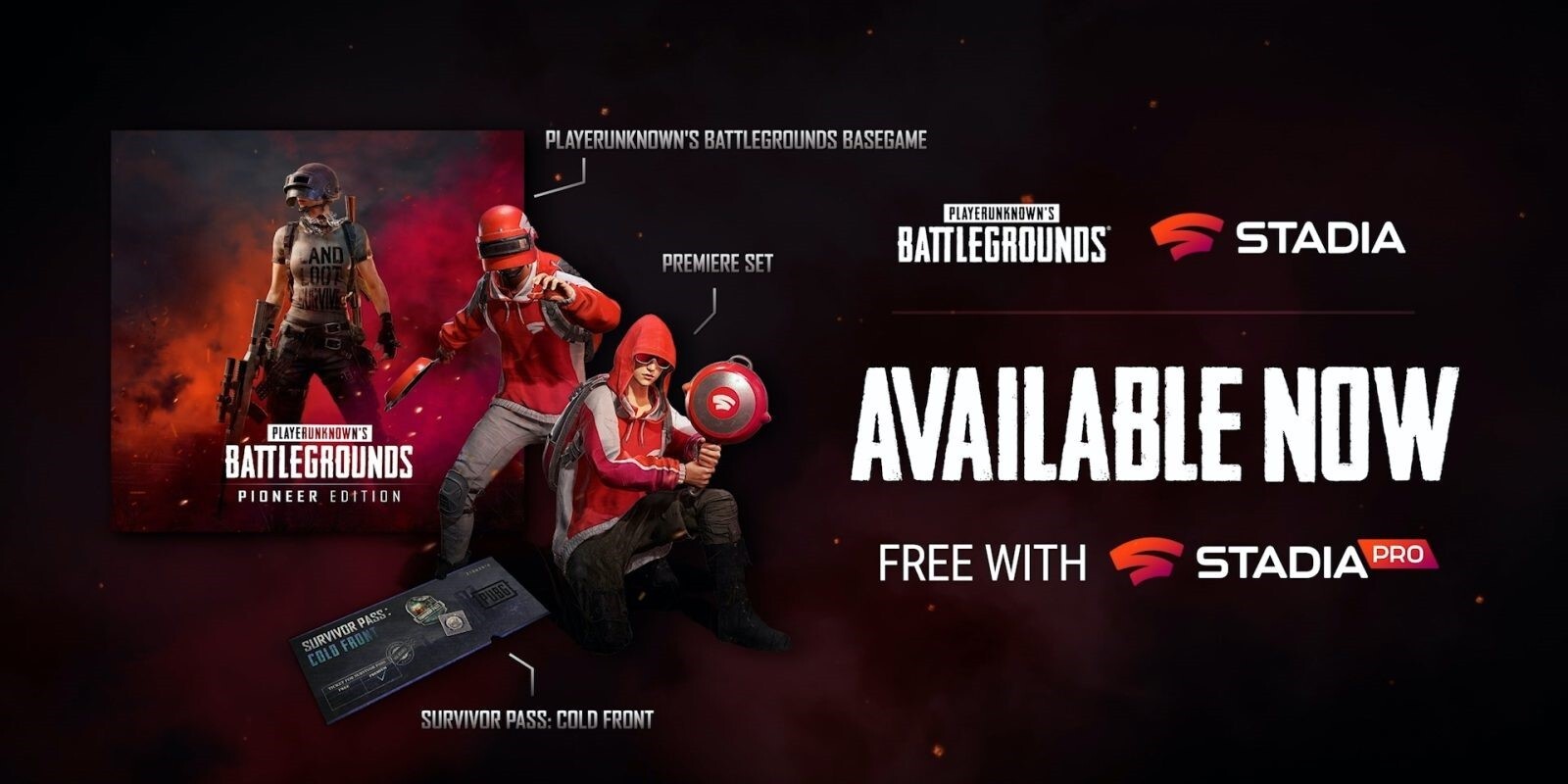
In line with the plan to release new games beyond Stadia’s initial launch, PlayerUnknown’s Battlegrounds (or PUBG for short) was selected as the first battle royale shooter to be adapted for the platform, with Virtuos executing the project in close partnership with PUBG Corporation and Google.


Mandate

The team working on PUBG for Stadia was charged with four objectives:

- To exhibit beyond any reasonable doubt that an adaptation of the game for Stadia was viable;
- To ensure stable framerate at all times;
- To upgrade and validate select middleware to allow Stadia support, and;
- To integrate Vulkan and Stadia support within Unreal Engine 4.16, to ensure proper rendering of the adaptation.

Challenges and Solutions

Throughout its development, there were several obstacles that the development team had to contend with for the adaptation of PUBG for Stadia.

Challenge #1: Stadia as a brand-new gaming platform

Unlike other consoles featuring years of iteration on their hardware and software, Google Stadia was an entirely new entity, which meant that the knowledge and experience required to develop and/or adapt a game had to be gained from the ground-up.

This, along with the fact that there were no pre-existing examples for reference, consequently presented the team with a project riddled with unknowns. Everything from the various features and functions of the platform, to the possible support of various control schemes was a question that needed answering before proceeding with the project proper.

The solution to this was a meticulous, comprehensive effort in researching what Stadia can offer and how it worked, while working against time to produce a proof-of-concept version of the game that could run on the platform.

Challenge #2: Laying the groundwork

Right from the start, the Stadia platform presented the team with two roadblocks to contend with. The first was that it featured an architecture based on a hybrid of Linux and Vulkan – a somewhat unique configuration. The second was that the version of Unreal Engine 4 used by PUBG did not support Stadia natively at the time.

In order to successfully show that adapting PUBG to Stadia was possible in the first place, the team first had to invest a significant amount of time and effort into implementing Linux and Vulkan compatibility to the game, while also modifying the UE4 engine to follow suit. Once that was done, the team’s focus shifted to upgrading the relevant middleware to support the platform.

The last and most important milestone for the team was to confirm that this set-up was able to run and render the game, and project the final stream successfully onto a test client device.

Upon verification that this was accomplished, the adaptation work consequently began proper.

Challenge #3: Maintaining stable framerates

As an online multiplayer shooter, it was paramount that PUBG for Stadia run seamlessly across all devices, with no latency nor framerate issues.

The latency part proved to be surprisingly manageable; there were little to no problems of the sort plaguing the team throughout the development process. In fact, the game ran without any hitches on days with decent internet connections, which is incidentally the deciding factor on whether or not a player would experience lag during gameplay.

The more intricate aspect of this challenge lay on the framerate side.

To achieve the best framerate possible, the team first analyzed the functions in the software’s program thread to learn which occupancy rates were higher, before optimizing said functions to reduce the occupancy rates. Next, they paid attention to the quality of the art assets used in-game; if the visual effects are set too high, the increased load on the GPU would may in turn affect the framerate. A balance thus had to be achieved between optimization and fidelity, the exact degree of which was agreed upon in another round of discussions.

To Stadia’s credit, the sheer processing power of the servers working behind the scenes meant that it was possible to achieve a stable framerate and reduce input lag while preserving graphical quality was exceedingly doable.

Challenge #4: Access to Stadia Dev Kits

The team that was assigned to tackle this project is based in Virtuos’ Shanghai studio. While having amassed significant experience in adaptations from prior projects, their location soon proved troublesome as they had no local access to the Stadia Dev Kits.

This issue was solved in two parts. First, part of the team was dispatched abroad to another Virtuos studio in Paris which had the dev kits onsite, allowing the selected personnel to interface with them in person. The rest remained where they were in Shanghai and continued their work via remote connections with the dev kits. This arrangement was met with huge success – since the conclusion of the project, Virtuos has progressively implemented more remote accessibility to various dev kits for its dev teams, allowing sustained productivity even while outside of studio premises.


Conclusions and Takeaways

The team behind the adaptation of PUBG for Stadia was able to conclude several new findings from their experience:

Stadia as a platform is indeed revolutionary. No downloads required, no loading screens, instant boot-up times, accessible on multiple devices including mobile phones and TVs means that players can enjoy unprecedented access to games no matter their location.

Aside from a decent network connection, not much else is required to run Stadia optimally. This also has the benefit of reducing latency by a large amount; on a good network connection, the team can hardly feel the effects of lag on PUBG, with the game running smoothly on Chrome.

One of Stadia’s underrated advantages is the elimination of virtually all cheats and hacks, due to the fact that the game is run entirely offsite, with none of the files stored locally and susceptible to manipulation.

Provided that a good network connection is available, and live environment is accessible, developers may have an easier time making games for Stadia, as it is possible to review the build remotely at any time, on a wide range of supported devices.

Existing middleware and tools compatible with Stadia are noticeably fewer compared to other contemporary platforms (at the time of development), which may be a possible hindrance for developers wishing to make games for the platform.

Remote connections to dev kits may likely be the norm in future for developers without direct access to one, and is already a reality in Virtuos today.

Clients are also able to review builds for Stadia games remotely at their location of choice, without the need to use physical dev kits. The hassle of delivering hardware is virtually eliminated in this case, granting an understated advantage over other platforms (especially when factoring in global logistic issues due to the COVID-19 pandemic).

With the completion of this adaptation, Virtuos has gained significant experience in terms of game development for Google Stadia, and is now already working on several new adaptations to bring more games to the platform, giving players access to the ‘Click and Play’ experience everywhere.

About Virtuos

Founded in 2004, Virtuos Holdings Pte. Ltd. is a leading videogame content production company with operations in Singapore, Canada, China, France, Ireland, Japan, Korea, the United States, and Vietnam. With 1,600 full-time professionals, Virtuos specializes in game development and 3D art production for AAA consoles, PC and mobile titles, enabling its customers to generate additional revenue and achieve operational efficiency. For over a decade, Virtuos has successfully delivered high-quality content for more than 1,300 projects and its customers include 18 of the top 20 digital entertainment companies worldwide. For more information, please visit: www.virtuosgames.com

Virtuos Experts Talks #9: How Virtuos-Sparx* Successfully Implemented A Crash Course on Remote Working

Article / 10 December 2020

The ninth in a series of regular articles highlighting learnings and best practices from Virtuos' global development, Art and VFX teams.

In this installment, Technical Director Fernando Castillo and Technical Group Producer Huy Nguyen talk about how they tackled COVID-19 and remote working.

As the COVID-19 pandemic makes its way across the globe, millions around the world have taken to social isolation at some point in order to slow the spread of the virus. This massive shift in societal norms has consequently forced businesses to suspend operations or to rapidly adapt by any means necessary. As one of the few industries heavily reliant on computers as a means of production and distribution, digital entertainment companies such as Sparx* have largely remained operational by swiftly implementing remote working arrangements.

In Sparx*’s case, working from home was largely a concept that was only considered theoretically; all the pieces required for it to function was available, but a definite playbook had not yet been drafted, much less trialed.

At the time of writing, Sparx* has already reopened its studio premises, after having completed three full weeks of self-imposed work-from-home arrangements for all staff during the month of April this year. The COVID-19 risk, while not completely eradicated, has been reduced to such an extent that businesses in Ho Chi Minh City (where Sparx* is situated in) have already begun resuming operations.

All in all, the remote working experiment was a success, although there were plenty of lessons learned along the way. This article will attempt to explain those discoveries in more detail.

The Situation

Sparx*’s first inkling of the impending crisis surfaced in the days following the Lunar New Year celebrations.

By this time, the coronavirus had already been recognized as a major issue by the studio management, which prompted high level discussions regarding the proper measures needed to mitigate the risk of infection.

The idea of closing the entire studio was floated in the early stages, but was eventually discarded due to the following reasons:

  • Closing the studio would cause its commitments to lapse, potentially damaging Sparx*’s reputation and losing clients as a result.
  • Some staff might have to take pay reduction/unpaid leave if the lockdown prolonged, as this happened to other companies in the industry.
  • An inoperative studio would mean no means of securing new projects for the duration of the closure, which at the time had no definite end date in sight.

The only other alternative was to send people home, but to keep the studio open by allowing them to work from home. This proposal quickly gained majority favor, and an emergency strike team was hastily formed to organize and execute the shift towards remote working.

Within days, an action plan was drafted up, with trials beginning that very weekend.

Case Study: Riot Games

Riot Games was one of the first clients to reach out and inquire about Sparx*’s status regarding the COVID-19 situation. At that time, the plan to shift towards full remote working had just been drafted, which meant that they were one of the first clients to be notified about the studio’s intentions. In addition, Sparx* also shared their proposed security method and projections for anticipated productivity loss when full remote working is achieved.


The eventual decision to select the teams working on Riot Games projects as the spearhead of this undertaking was based on several factors:

  1. Riot Games showed explicit concern regarding the staff’s wellbeing. Throughout the meetings, Riot continuously stressed the importance of ensuring the safety of Sparx*’s staff over their productivity output. Riot was also receptive to the proposal to implement full remote working, even though it was still unfamiliar territory ground for the studio.

  2. Punctual delivery of Riot’s project milestones was critical. As Riot’s offerings are exclusively live service games (e.g. League of Legends), all future content is planned well in advance, which meant that delays in production would be highly disruptive for Riot as a client. Ensuring that Riot’s production pipeline could continue uninterrupted was therefore critical.

  3. Riot Games is considered a critical partner for Sparx*. With this unique relationship between the two entities, careful management of their projects was deemed necessary.

Implementing Remote Working: Problems and Solutions

There were three distinct issues that were encountered throughout the planning, testing and execution of the remote working arrangements, which were subsequently resolved via various measures.

Technical challenges

As an external developer, Sparx* often handles projects involving a myriad of work scopes, tools and game engines, which consequently require unique set-ups in order to function correctly.

While not an issue in a standard office environment, the incompatibilities of some game engines turned out to be particularly problematic when handled via remote working. This required extensive testing for multiple applications in order to find a suitable configuration that can support their use.

Another potential problem anticipated by the studio was the quality of equipment that staff members had access to at their homes, such as monitors, connection cables, or drawing tablets to name a few. In a pre-emptive move, Sparx*’s HR department sent out online surveys within the first few days to gauge staff readiness – if a person was found to not possess the required components, the studio would allow them to borrow what they needed from the studio.

In addition to hardware, all staff were also required to familiarize themselves with several remote desktop applications to ensure uninterrupted workflow:

  • TGX: a remote desktop application that utilizes a compression algorithm to increase bandwidth and optimize performance. This allowed Sparx*’s artists and animators to proceed with their work when interfacing with offsite workstations, with no disruptions caused by connection issues.
  • RemoteFX: An extension by Microsoft, RemoteFX is a Remote Desktop Protocol that optimizes the transfer of graphics information through remote connections, an advantage readily taken by the studio’s FX artists.
  • Datacloak: An encryption program used for securing data housed in servers and workstations.

The heavy reliance on IT equipment and the ability to connect to them necessitated a well-established support system to ensure their reliability, prompting the following actions:

The creation of a technical support group chat on Zalo (a local social communication platform), and

Assigning one Technical Artist and one IT executive to each team, for the exclusive purpose of addressing any technical issues affecting remote working capability.

The solving of these pain points consequently allowed Sparx* to proceed with the implementation of remote working for all studio staff.

IP Protection

As an external developer, security and client’s IP confidentiality at Sparx* is paramount. 

Sparx* therefore reached out to the clients for each active project, informing them of their plan to implement remote working for the entire studio and providing details of its execution before formally asking for permission to do so. Only when proper authorization is secured can Sparx* proceed with its plan to send its staff home.

Fortunately for the studio, every single client contacted was willing to allow that to happen, starting with Riot Games. At the conclusion of the remote working arrangement three weeks after implementation, Sparx* had succeeded in maintaining all IT security certificates, Working remotely using the right technical solutions is just as secure and Sparx* observed that the autonomy and trust conveyed to staff translated into greater care assigned to confidentiality.

Productivity

The transition to working in a shared office environment to working remotely from home requires a change in mindset. In the first few days of the remote working arrangement, Sparx* encountered a drop in productivity amongst the staff.

The studio however recognized that the drop may only be temporary, brought on by a ‘culture shock’ of working from home for the first time. To inspire an increase in productivity, the studio launched several initiatives, including a limited-time event that aimed to encourage artists to hit assigned milestones for set rewards.

These measures, complemented by the studio’s culture of mutual encouragement and constant communication eventually brought about a recovery in productivity rates. At the end of the remote working arrangement, Sparx* was found to have completed all forecasted deliverables set for the studio’s teams.

“The WFH transition with Virtuos-Sparx* was extremely smooth and well documented the entire way. We were kept up to date on status of blockers and what the team was already doing to address them. Once we made the full transition, it took us one week to get back to the same cadence we came to expect with in house developers. Super impressed!”, says Sarah Reinstein – Producer at Riot Games.

Conclusion

A few data points can be gathered from this experiment in remote working:

  • Sparx* sent its staff home in batches of 20–25 people, with the last batch dispatched right before the order for social distancing was issued by the Vietnamese government.
  • Over 400 studio members in total were sent home for the sake of the staff’s safety.
  • The total time taken to implement remote working, from planning to execution, was 2–3 weeks.
  • The remote working arrangement lasted a total of 3 weeks.
  • Overall productivity remained at 100 percent.

While Sparx* has been ultimately successful in achieving full remote working capability through effective troubleshooting of various issues, the major contributor for its success is arguably the level of cohesion exhibited by each studio member throughout the experience.

Sparx* boasts great teams not just in its production departments, but also its administrative ones as well – Management, HR, IT and Internal Communications. With their help, the studio as a whole was able to remain alert by actively monitoring the rapidly evolving situation, and react accordingly. The studio-wide communications channels were also set up to be wholly transparent, which allowed for consistent messaging to allay fears and dispel rumors.

Besides the concerted efforts of the administrative teams, the studio culture itself also played a significant role in ensuring a smooth transition to remote working; the ingrained sense of mutual cooperation and morale upkeep became the pressure release valve that kept the studio united in purpose as they remained isolated in their individual homes, complemented by numerous grassroots activities aimed at preserving that connection throughout this period of time. For Sparx*, this was the secret ingredient that made it all possible.

About Virtuos

Founded in 2004, Virtuos Holdings Pte. Ltd. is a leading videogame content production company with operations in Singapore, Canada, China, France, Ireland, Japan, Korea, the United States, and Vietnam. With 1,600 full-time professionals, Virtuos specializes in game development and 3D art production for AAA consoles, PC and mobile titles, enabling its customers to generate additional revenue and achieve operational efficiency. For over a decade, Virtuos has successfully delivered high-quality content for more than 1,300 projects and its customers include 18 of the top 20 digital entertainment companies worldwide. For more information, please visit: www.virtuosgames.com

Virtuos Experts Talks #8: Building A High Quality Procedural Effects Pipeline

Article / 10 December 2020

The eighth in a series of regular articles highlighting learnings and best practice from Virtuos' global development, Art and VFX teams.

A Brief History

Ever since its humble beginnings, Virtuos has relied on a comprehensive set of tools to provide art, animation and game development services to clients worldwide. Houdini is one such tool that has seen extensive use in the making of both games and film.

Virtuos first began using Houdini to animate scenes in TV series, often in tandem with 3D rendering programs such as Maya or Mental Ray. One prominent example can be found in Star Wars Rebels, with various VFX such as the molten metal effects caused by lightsabers being made in Houdini. The software is also primarily responsible for creating the laser and ship destruction effects found in the space battle section at the end of Season 3.

Case Study: Age of Empires II: Definitive Edition

As the long-awaited remaster of a true RTS classic, Age of Empires II: Definitive Edition was a project that demanded meticulous care and attention, which meant that no expense was spared in ensuring that every detail was updated to the highest quality. True to this mandate, the final version of the game sported numerous features, including 4K resolution support, a richer color palette, better lighting effects and redesigned units and base structures.


Part of the scope for redesigning the structures included a graphical fidelity upgrade in the destruction effects. As the majority of the core gameplay loop revolved around the construction and leveling of these structures via battles and sieges, it was paramount that the effects used to depict crumbling buildings were of the highest quality possible, while still retaining some uniqueness in the manner of destruction across a wide variety of structure types. The ability to zoom in closer to the game environment also necessitated a destruction sequence that not only had to be smooth in terms of frame-rate, but also required the textures to hold up under close scrutiny.

The Problem

To ensure high-quality visual effects of any sort, the most obvious solution would be to assign a dedicated artist to manually create the animation itself. But that wasn’t feasible in this case, because of one overarching reason: there were just too many structures to animate by hand within a reasonable amount of time. Even if it were possible to do so, the resulting time and budget constraints would very likely have forced down the overall quality of the destruction effects.


The need to produce the required effects in an acceptable quality within these imposed restrictions meant that another alternative had to be found.

Generating Procedural Destruction Effects with Houdini

One of Houdini’s major selling points is the ability to generate complex simulated effects, but its true strength lies in its procedural nature and the ability to create a setup once and having it work with different input geometries. This justified its adoption as the primary method to create the destruction effects in Age of Empires 2: Definitive Edition.

Before the team began work on production, they first had to create a custom tool to handle their needs. This tool was designed to provide an array of editable parameters to the Houdini team, which would affect the destruction effects in such a way that allowed for maximum customization while ensuring physical and visual consistency. Aside from that, it also supports the automated generation of a constraint network, relative to the type of material specified. This allows different building materials in the game to simulate resistance to external forces realistically; wood will typically bend before it splinters, while stones will crumble directly. Aside from that, the tool is also able to handle other materials such as fabrics, which would be processed through a cloth simulation pipeline.


With the development of the tool complete, the Houdini team proceeded with the creation of the destruction effects, using building models created by the asset department from Virtuos. Each of the models was built from the ground up and designed to be almost identical to the version found in the original game. Once built, the model file was exported as Alembic format (.abc) for use within Houdini.

The artist assigned to the task then generates different variations of the destruction effects by tweaking a limited array of parameters, displayed in an easily-accessible interface provided by the custom tool mentioned earlier.

One of these parameters concerns the physics of each type of building material – wood, metal or stone, among others. This drives the way in which the structures behave as parts of it fracture and fall apart, making the destruction effects look more realistic. 

Once satisfied with the fracturing process, the artist responsible for that building proceeds to link several fragments of it together with an ‘unbreakable constraint’. When a building is destroyed, it splits into multiple pieces and collapses. Linking pieces together with this constraint allows larger pieces to survive intact, creating the illusion of organic destruction and the formation of ruins, rather than a meaningless pile of debris.


At this point, the destruction effect would be considered close to completion. The artist makes some additional cosmetic changes, fine-tuning the animation by arranging specific sections of the structure to fall away in a more visually-appealing sequence, before finally compiling a playblast for approval by the Art Lead or Director. If deemed satisfactory, the destruction effect is subsequently exported to 3dsmax for the rendering process.

Results and Conclusions

Throughout this part of the project, the development of the custom Houdini tool proved to be the most time-consuming task, taking two weeks in total. Once that was complete, it was smooth sailing; the Houdini team managed to generate and polish the animations used for every building in the game within a matter of hours. In the end, each building possessed a destruction effect that while unique, still retained a consistent destruction behavior that fits within the aesthetics of the game.


The time spent working with the procedural generation tool in Houdini has revealed several noteworthy points:

  • It was highly useful for generating bespoke animations relatively quickly and without much difficulty.
  • The time saved allowed the Art team to devote more attention to the overall art direction for Age of Empires II: Definitive Edition.

Based on this success, Virtuos now plans to capitalize on it by concentrating on the following areas:

  • Substantially expand the existing Houdini team.
  • Start an internal project to develop and connect even more tools into Houdini for even more versatility, such as using Houdini to also procedurally generate buildings for instance.
  • Construct an ever-growing library of digital assets for use within Houdini and/or game engines.
  • Look for more opportunities to utilize Houdini in terms of procedural landscape generation in other projects, including perfecting our procedural assets placement solution to automatically generate object-dense environments (e.g. forests).
  • Further enhancing procedural level creation capabilities in 2020.

There is no doubt that procedural and AI-assisted technologies will play a much bigger role in the games industry in the years to come, and that Virtuos fully intends to leverage them in its ongoing mission to deliver top-tier art assets for games.

About Virtuos

Founded in 2004, Virtuos Holdings Pte. Ltd. is a leading videogame content production company with operations in Singapore, Canada, China, France, Ireland, Japan, Korea, the United States, and Vietnam. With 1,600 full-time professionals, Virtuos specializes in game development and 3D art production for AAA consoles, PC and mobile titles, enabling its customers to generate additional revenue and achieve operational efficiency. For over a decade, Virtuos has successfully delivered high-quality content for more than 1,300 projects and its customers include 18 of the top 20 digital entertainment companies worldwide. For more information, please visit: www.virtuosgames.com

Virtuos Experts Talks #7: Interview: Xavier Rozé and Paul Loumouamou on Co-Engineering Assassin's Creed® Liberation Remastered

Article / 10 December 2020

The seventh in a series of regular articles highlighting learnings and best practices from Virtuos' global development, Art and VFX teams.

In this installment, Technical director Xavier ROZÉ and Game Producer Paul Loumouamou talk about their exciting and challenging co-engineering project — Assassin's Creed® Liberation Remastered.


The Assassin's Creed® franchise has a unique place in the gaming world. Since Assassin's Creed release in 2007, the series has released 11 titles, which have always maintained a high quality of production. Now Assassin’s Creed® Odyssey is taking the franchise to the next level.

A few years ago, Virtuos became involved in the adaptation of this legendary series, taking Assassin's Creed® The Ezio Collection from PlayStation® 3 and Xbox 360 to PlayStation® 4 and Xbox One with post-effects improvements.

This time, Virtuos has a greater challenge — co-engineering Assassin's Creed® Liberation Remastered. Technical Director Xavier Rozé and Game Producer Paul Loumouamou from Virtuos' Paris studio are the project's key players. They were excited to share their expertise on how this tough mission accomplished.

What role did the team play in developing Assassin's Creed® Liberation Remastered? What do you think you and your Virtuos team brought into the game?

Paul: Our role was to adapt Assassin's Creed® Liberation so it is playable on machines that are more powerful: Xbox One, PlayStation® 4 and PC. However, our main mission was to improve the game's graphic level so that it would reach the visual quality of a modern next-gen title. We wanted to make sure this would match the visual benchmark of the machines it has played on, which are much more powerful than the console of its original game. To achieve this, Virtuos provided a lot of technical and creative expertise by implementing new graphics features such as Physically-Based Rendering (PBR).

Assassin's Creed® Liberation Remastered belongs to the Assassin's Creed® Odyssey's season pass. You've worked on the Assassin's Creed® series before, how does this compare to your previous projects, especially the Ezio collection?

Paul: We have had many successful projects that are similar to this and have accumulated a vast amount of experience in adapting games. But this time around, we modified even more things than on The Ezio Collection. In Assassin's Creed® Liberation Remastered, we added more post-processes, reworked the rendering and improved the lighting. We even modified the gameplay with new features, such as free-aiming, and reworked many controls, like the canoe transportation system.

Xavier: We have also strongly enhanced existing surfaces to a much higher quality. We've integrated a dynamically tessellated water system to render swamps and seas with faithful real-time wave behaviors and implemented a parallax occlusion mapping method to bump the relief of the grounds, especially the snow surfaces.


Was the game being developed on three platforms simultaneously? How was the development process balanced across all three platforms?

Paul: Yes, we started with the PlayStation® 4 and Xbox One version and we started working on the PC version after a few months, so all three platforms were being developed at the same time. Both console versions were almost identical from a gameplay and visual point of view, whereas the PC version was much more specific. We had to take into account the hardware gap between PC and other consoles to make sure all three versions delivered the same gameplay quality in different technical conditions.

What are the gaps and differences you mentioned between PC and consoles here?

Paul: The biggest technical difference comes from the hardware itself. PlayStation® 4 and Xbox One are the same for all users while PCs have many different hardware configurations. This difference required us to do a lot of testing to avoid problems linked to particular components. An example would be how NVIDIA and AMD graphics cards do not work the same way and can therefore cause different bugs. There are also other differences such as keyboard controls and the differing PC resolutions that have a significant impact on the game's UI.

Have you worked on projects using Anvil engine before? What are the characteristics of this engine? What are the advantages and disadvantages of both proprietary and commercial engines from a development perspective?

Paul: Yes, we used the same engine for The Ezio Collection. Anvil has a “what you see is what you get” kind of philosophy as it's similar to commercial engines like Unreal Engine 4 or Unity. Everything can be done inside the editor. It's really helpful when you want to iterate quickly. Commercial engines are easy to learn and can work with many different types of games, but they can be harder to optimize and might not perform as efficiently as proprietary engines designed for specific types of game.

Xavier: Anvil has been designed with open-world in mind from the beginning. This allows the engine to support strong level content streaming without trouble regarding the framerate, the content density and the dynamic living environment.

Did the team encounter many iterations during the Assassin's Creed® Liberation project? What types of iterations were encountered?

Paul: We worked closely with Ubisoft Barcelona, which worked in parallel on Assassin's Creed® III Remastered. We worked together to improve the overall quality of the games and the harmony between the two. A good example of our iterations on Assassin's Creed® Liberation Remastered is the PBR, where we had to constantly tweak the post-processes and lighting to take advantage of our new materials.

In recent years, due to the continuous improvement of hardware performance, Physically-Based Rendering has been widely used in real-time rendering of PC and console games. To what extent do you think this new rendering pipeline has changed the development?

Xavier: PBR is a new lighting model more accurately based on realistic optical formulas. This new technique has really spread with PlayStation® 4 and Xbox One. I think PBR has simply allowed the video game industry to enter a new age of visual quality because it creates a universal standard that all production teams can build on. PBR offers us the tools and metrics to ensure the player gets fully coherent rendering scenes which sublimate the intent of the original art direction.


What was the unique thing about the lighting through PBR rendering?

Paul: The unique thing is the link between the lighting itself and the different reactions of the materials. We had to rework the lightning to take into account how our new materials would react in the same environments from the base game. It was crucial to understand and control all of these interactions to retain and enhance the original game's atmosphere without heavy alterations.

Xavier: Lighting with PBR offers the opportunity to reveal what the materials really are and how different they look to each other. The player can immediately distinguish the metallic buttons on a leather coat and observe the oily skin of a character behind a silk scarf. This brings the player into a whole new level of immersion.


Were there any challenges with PBR rendering during the co-dev of Assassin's Creed® Liberation Remastered?

Paul: We had two main challenges; maintain the artistic direction and implement PBR in the game in a short timescale and with a small team. To address the problem of artistic direction, we organized weekly reviews based on a side-by-side comparison with the old game. This enabled us to highlight what we might have lost compared to the previous version and to continually correct our trajectory.

Xavier: The biggest challenge, in my opinion, has been to make the use of PBR instantly obvious for any fresh eyes looking at it. During the production, we would compare the original and remastered versions and we got more and more familiar on the content we compared. We came to a moment where a comparison outlined a big difference for us, but this difference was almost not perceptible to a newcomer! There, we realized that we needed to become stricter in our review expectations, so we would never forget that the results must be obvious for all newcomers to the game.

Technology is influencing art, changing art, redefining art. How can technology better serve the art performance of gaming coherently? What do you think of the paradox between art and technology in game industry?

Xavier: As technology is advancing, it provides new possibilities and new ways of thinking. The art of tomorrow can emerge from unexpected combinations of practices issued from the technologies of today. This is the reason that pushes us to improve current technologies, so that we can give new means to artists for fully expressing their messages to players. This is a cycle where technology should always be seen as an opportunity and not as a constraint for art expression. Whereas technology is a fully determined flow of logic, art is a muddle of effects feeding human emotions according to a global intent. The challenge when building a game is combining the strict structure of technology with the messy nature of art. This will produce a more coherent and realistic experience for players to immerse themselves. Finally, the more present the technology, the more visible the art.

You have previously worked on several other Virtuos co-development projects, such as Vampyr and LA Noire. What do you think of co-development after having these valuable experiences? What effect do you think co-development has on the AAA game industry?

Xavier: Co-development is a marvellous opportunity to share experiences between our client's teams and ourselves. This solution merges different team's profiles, converging to a solid bulk of expertise and processes which become reliable enough to lead a project to a safe end.

Co-development only happens when needed, for a specific and well-determined target. Which lessens risks and streamlines the production effort thanks to teams experienced working in various situations and client expectations.

Thanks to Xavier and Paul for taking the time to share their valuable perspectives and stories. Make sure to check out Virtuos Expert Talk Series here. Assassin's Creed® Liberation Remastered and Assassin's Creed® III Remastered released for the PlayStation®4 computer entertainment system, the Xbox One family of devices including Xbox One X and Windows PC on March 29, 2019.

About Virtuos

Founded in 2004, Virtuos Holdings Pte. Ltd. is a leading videogame content production company with operations in Singapore, Canada, China, France, Ireland, Japan, Korea, the United States, and Vietnam. With 1,600 full-time professionals, Virtuos specializes in game development and 3D art production for AAA consoles, PC and mobile titles, enabling its customers to generate additional revenue and achieve operational efficiency. For over a decade, Virtuos has successfully delivered high-quality content for more than 1,300 projects and its customers include 18 of the top 20 digital entertainment companies worldwide. For more information, please visit: www.virtuosgames.com

About Xavier Roze

Serving as Technical Director at Virtuos Paris Studio.

Xavier ROZÉ has over 16 years' experience in the game industry, with solid experience on performance optimization, especially in streaming open worlds on unreal engine 3&4, rendering and consoles development.

About Paul Loumouamou

Serving as Game Producer at Virtuos Paris Studio.

Paul LOUMOUAMOU has over 3 years of experience in the video game industry, with a dedicated producer and a gameplay programmer technical background. He has experience in Team management, Scrum / Agile methodology and Gameplay Development / Game Producing on PC and consoles.