Virtuos Insider: Luo Jiezhi Talks About What it Takes to Be a Great Game Artist

General / 07 July 2022

This article is part of Virtuos Insider, a series of interviews where Virtuosi share about their careers and experiences in the company and video game industry at large. In this installment, we chat with Luo Jiezhi, an assistant art director at Virtuos Shanghai who started out with us as a junior artist in 2012.

When it comes to creating game art, Luo Jiezhi, our Assistant Art Director in Environment Art at Virtuos Shanghai knows it all. Jiezhi first discovered his dream to become a game artist after he was introduced to the world of AAA games as a child, proceeding to study Game Art and Design in college. Attracted by the variety of AAA game projects at Virtuos, he joined us in 2012 as a junior artist and eventually climbed the ranks to become an assistant art director today.
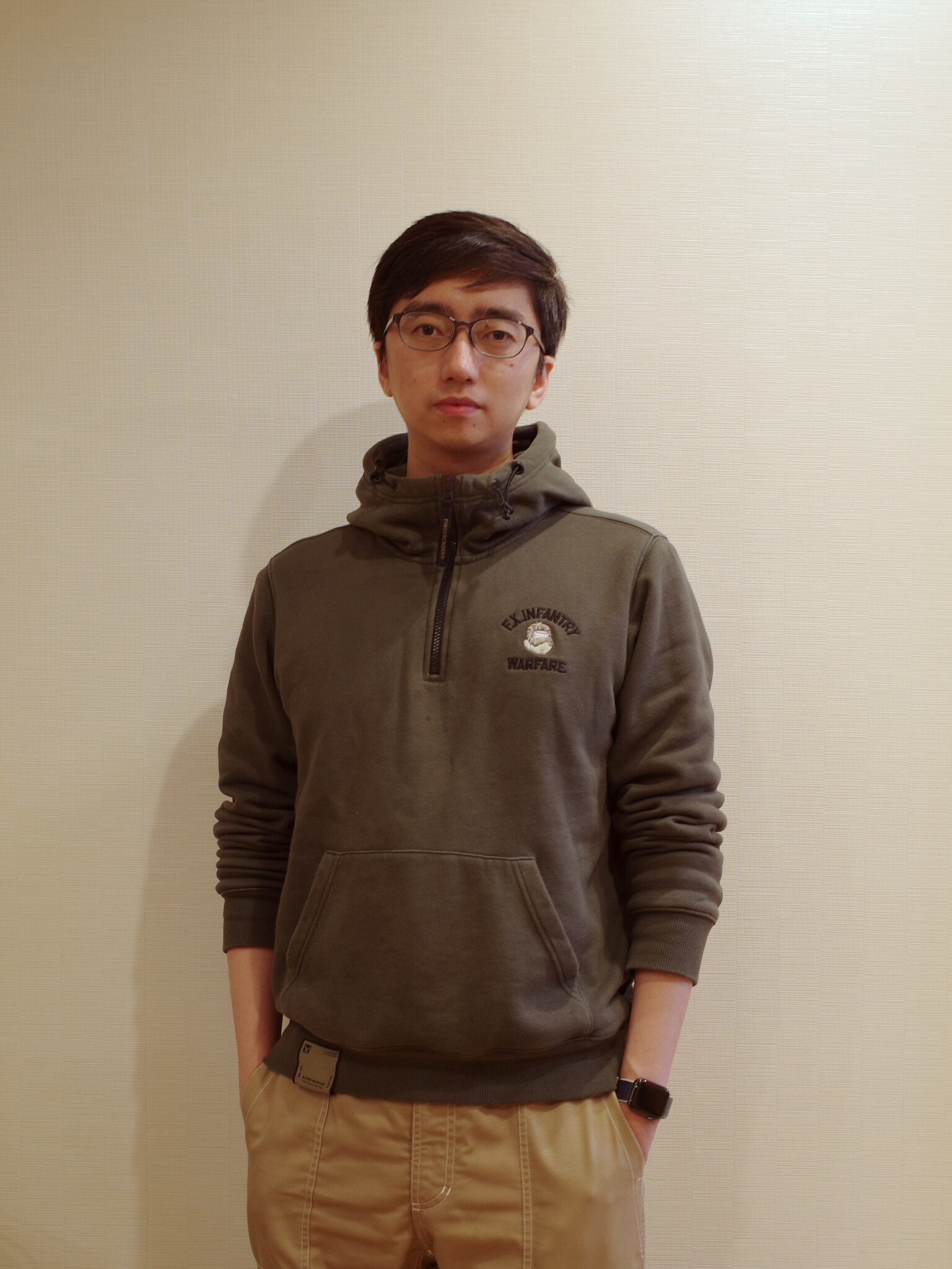
Luo Jiezhi, Assistant Art Director, Virtuos Shanghai

We spoke to him about his experience at Virtuos Shanghai and heard more about how he helps cultivate young artists into great industry professionals.

Tell me more about your career history at Virtuos and how you came to join us back in 2012.

After graduating from college in 2011, I started working at a different game company. However, at the time, I had already heard about Virtuos and the AAA games that it was working on, which included some of my favorite ones. When I was offered the chance to work at Virtuos as a junior artist, I jumped at the opportunity without hesitation, and the rest is history. I’ve been at Virtuos for 10 years, and I’m delighted to have worked on so many famous titles, including Horizon Zero Dawn, Horizon Forbidden West, and Shadow of the Tomb Raider.What sparked your interest in game art and design and motivated you to pursue it as a career? When I was a young kid back in 1993, my dad bought me my first console as he thought that it was important for children to learn more about new technology. That opened my eyes to the world of games and since then, I’ve been hopelessly hooked on it. As I grew older, I started playing AAA games such as Zelda and God of War, and I was fascinated by their game graphics and visuals. I believe that’s when my dream to become a game artist started.

Could you tell us more about what you do as an assistant art director?

As an assistant art director, I guide our teams’ art direction, project quality, and monitor progress to ensure we can deliver high-quality work on time. Before starting on a new project, I would study and understand the artistic requirements of the project, then translate them for my team members in a way that they can understand well.
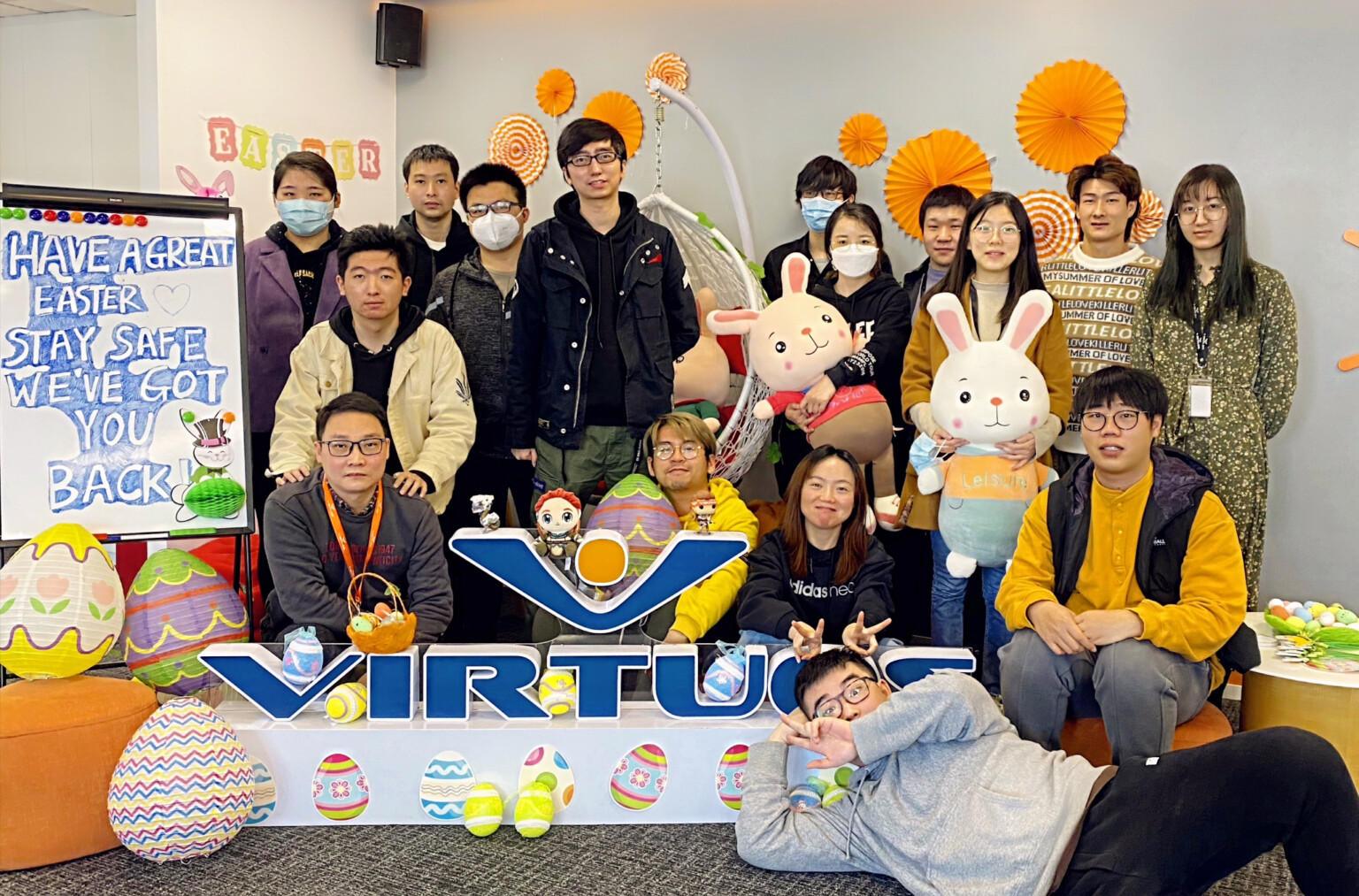
Jiezhi and his team in Shanghai

I also organize training for my art teams during the project process to ensure that the tools and methods we use are ahead of the curve. Besides training support, I provide my team members development plans that guide them to their ideal career paths and achieve their goals. Along with other senior art directors, I help to develop teams with unique characteristics that can synergize and work together to make games better, together.

What is the most memorable project that you’ve worked on at Virtuos?

That would have to be Horizon Zero Dawn. Back when I was a senior artist, we were tasked with creating the robots in the game. That was my first opportunity to work on such a big and complex project, and I was deeply impressed by Guerrilla Games’ movie-like design and art quality. While working on this project, I learned several techniques, including how to sculpt hard-surface models well using ZBrush. Besides technical skills, I truly realized the importance of pursuing excellence in whatever I do after seeing how amazing the final product of the game looked.

As a senior member of the art department, you work with junior artists regularly. How do you mentor and cultivate young artists and junior colleagues to become leaders themselves?

I try to loop our junior artists into projects as early as possible. In the early stages, I take the time to explain details, recommend techniques, and share my personal experiences with them. As they improve their skills, I will start assigning more complex tasks to help them to gain experience. While monitoring their progress, I usually provide them with some customized training tailored to their observed areas of improvement.

I also encourage them to improve their communication skills and find solutions to the problems they encounter by discussing with other artists in the team.

Through communicating with other team members, they learn to work better with people and gain the confidence to solve problems with their own ability, rather than to only rely on their seniors for solutions.My goal when mentoring junior artists is to encourage them to learn skills and accumulate experience independently.

Did you have someone who guided you throughout this decade at Virtuos, from a senior 3D artist to a team leader, and now, an assistant art director? Could you describe your learning process?

I think a lot of people have provided me with help and guidance in my journey, from my direct manager to senior members of the art department and Virtuos’ senior management. They’ve created a conducive environment for me to grow as an artist and leader, allowing me to take on more challenging projects over time. They’ve also been very responsive and accommodating to issues I’ve faced at work at times, communicating with me regularly.

At Virtuos, we have structured training support to help improve our technical skills and managerial abilities. Additionally, our Central Technology Group (CTG) often invites industry leaders and R&D experts to conduct lectures, giving us insight into the latest tools in game development to stay relevant.

We are also provided with certified training courses for professional managerial training. Besides such programs, Gilles, our CEO at Virtuos, also personally organizes internal sessions with us to share his management experience with us every year.

As a person and leader, I’ve learned to be more introspective and level-headed over time. When I was first promoted to a team leader, my seniors and mentor often reminded me to stay rational, think about problems from multiple perspectives, and make objective and reasonable decisions.

What are the three most important skills or traits that new artists should possess? What do you emphasize when teaching new artists?

There are three things that I usually advise new artists on – build a solid foundation of technical skills, have a strong and healthy mindset capable of overcoming challenges and hurdles, and possess a continued passion for games.

Basic skillsets are the fundamentals to achieving their dreams, which will carry them a long way as they progress further.

Furthermore, our projects at Virtuos are mostly AAA games that can be complex and challenging at times. An artist with a healthy mindset would be able to analyze problems with a rational mind and actively seek help rather than give up. Last but not least, our passion for games will help drive our careers in the video games industry and keep us motivated.

Tell us a bit more about yourself – what do you normally do on weekends and in your free time? Do you have a favorite game?

I enjoy playing basketball and taking walks along the Huangpu River with my wife during weekends and in my free time. Sometimes, I work on my personal game-related projects, and of course, playing games is an essential part of my life too! I’ve tried many games but my favorite is still the Zelda franchise, which has some of the best games that have ever been made, hands down.

Share with us a piece of advice that you’d give to your younger self and other young artists starting out in the video game industry.

Never fear challenges; trust your abilities, and your efforts will definitely pay off.
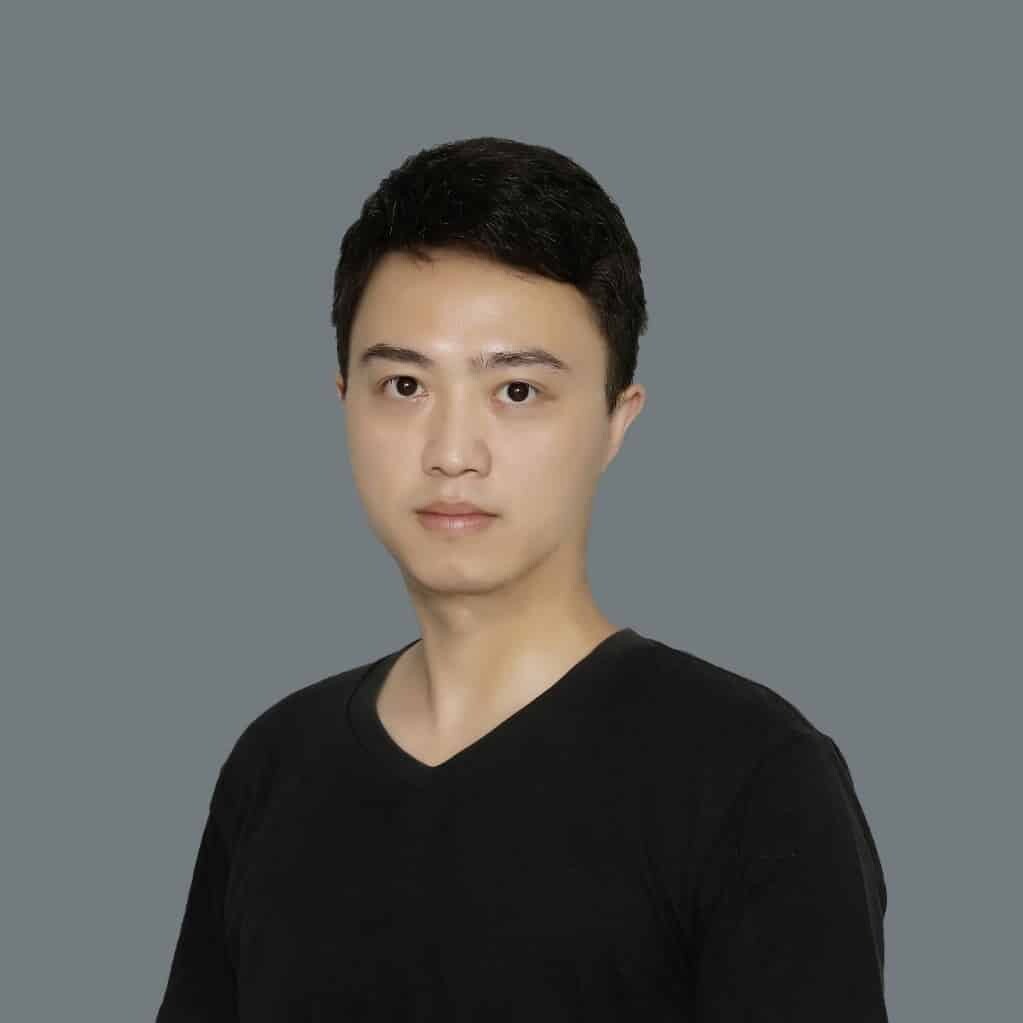
EXPLORE A CAREER WITH US AT VIRTUOS

Expert Talks: How Original Anime-Style Characters Are Created, As Explained By Virtuos Artists

General / 19 May 2022

This article is part of an editorial series of Expert Talks by Virtuos aimed at sharing the learnings and best practices in global game development and art production. In this installment, Chen, Lead Artist, and Jing, Senior Artist at Virtuos Chengdu take us through the process of creating original anime-style characters for a recent ACG Jam contest.

Anime art is a uniquely stylized form of two- and three-dimensional illustration and animation that originated in Japan in the early 1900s. Officially recognized by the Japanese Ministry of Education as one of the most important forms of artistic expression in modern Japanese culture in 2000, anime-style art has been highly popularized internationally in the form of films, animation and games. The art genre has also evolved over the years, with more realistic character designs and richer animation with each generation improving upon previous works.

While anime art may seem easy to the unknowing, an artist’s solid fundamental skills are essential when it comes to drawing high-quality anime art, despite how simplistic it may seem. To start off, the artist must possess a strong understanding of basic anatomy to draw believable characters, and have a good sense of perspective when drawing characters and backgrounds in order to create the illusion of a 3D object on a 2D surface. Besides anatomy and perspective, a good grasp of color theory concepts such as saturation, values and contrasts are also key to creating a visually pleasing and interesting anime art piece.

To give our artists an opportunity to explore and design various forms of anime-style character art outside of their regular projects, our team at Virtuos Chengdu organized an Animation, Comics and Games (ACG) Jam design contest for them to flex their creative skills.

The Design Brief

  • Participants can choose from three different submission categories – character illustration, character concept art, and illustration. They can submit to more than one category.
  • Artists should participate and send in their submissions individually.
  • Only original submissions are allowed.

“While the organizers were formulating the topic of this competition, we deliberately chose a style that has been rarely covered in the teams’ usual projects. The purpose of this ACG Jam is to explore the potential and hidden skills of our artists, and we are glad to see that everyone was able to showcase their versatility in art styles through the contest,” said Liu, one of the art directors on the judging panel.

“Besides our artists from the Concept Art department, colleagues from the 3D Character and Technical Art teams also took part in this contest and submitted unexpectedly impressive sketches, showing their artistic skills outside of their expertise.”

In this Expert Talks installment, we spoke to two of our winning artists in ACG Jam to learn more about how to create original anime-inspired characters.

CHEN: DRAWING INSPIRATION FROM FAVORITE BOOK TO CREATE ORIGINAL CHARACTERS

Chen, Lead Artist, Virtuos Chengdu

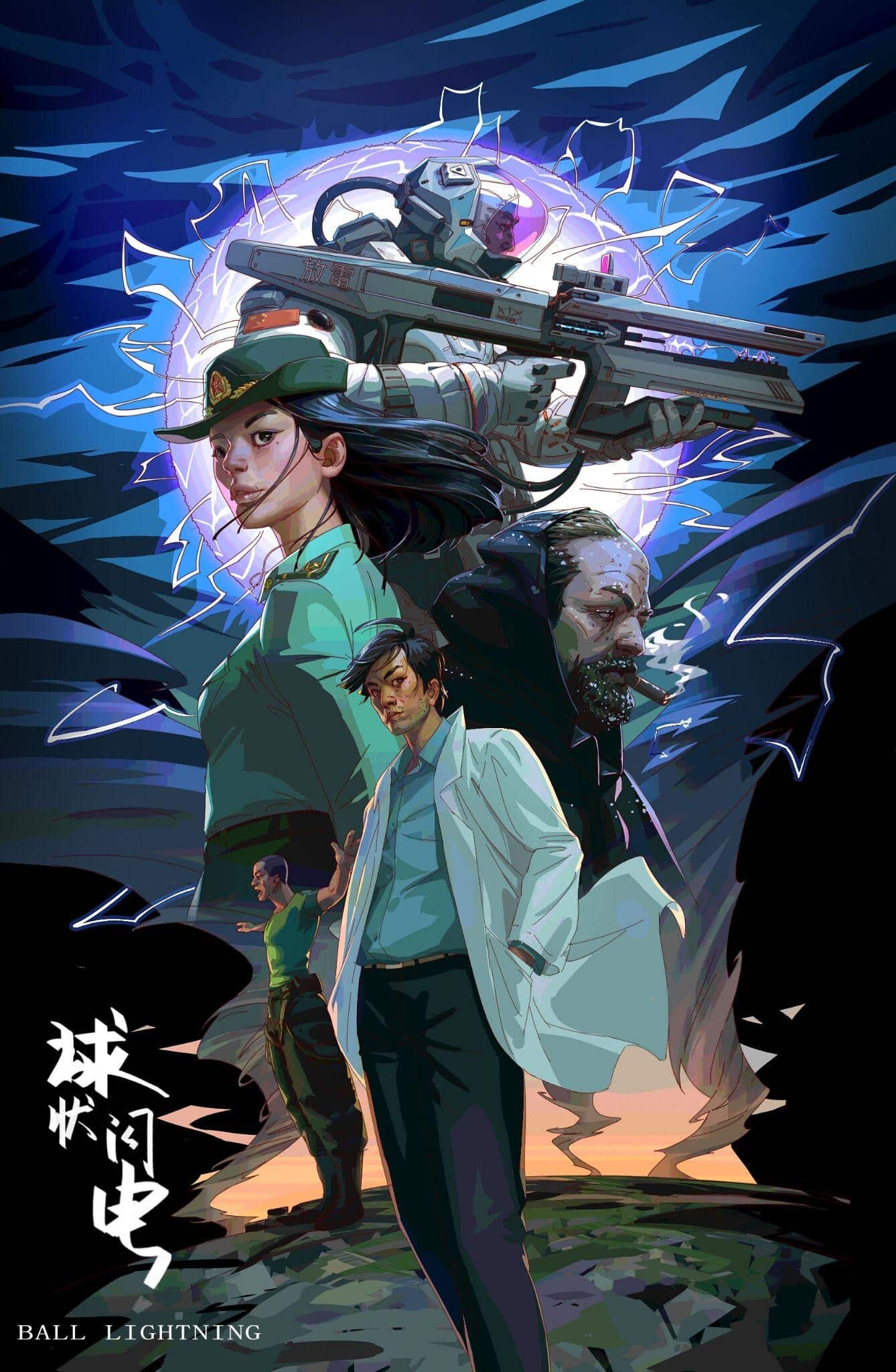
We spoke to Chen, the lead artist at Virtuos Chengdu who won the Most Popular Award in the ACG Jam with his submission titled “Ball Lightning”. The “Most Popular” award was determined based on internal voting by Virtuos employees.

“Ball Lightning” by Chen

Hi Chen, congratulations on winning the “Most Popular” award! Could you share with us about how you came up with the concept of “Ball Lightning”?

Chen: Thank you! Actually, this piece is named after “Ball Lightning”, a novel by the Chinese author Liu Cixin. I’ve been inspired by this novel on many occasions and I’ve drawn some sketches based on the story in my spare time. The story content has many interesting points and has brought me an endless stream of imagination.

When I decided to draw a sketch based on “Ball Lightning” for ACG Jam, I thought to myself, “How can a simple image depict the entirety of Liu’s novel?” It was just too difficult to work out. Eventually, I decided to design a book cover inspired by the story to express my admiration for it, portraying all the main characters of the story in the cover.

Is this your first time working with anime-style art?

Chen: I’ve experimented with anime-style art in the past, designing male and female characters for a project a few years ago. Back then, I wasn’t sure if I had completely grasped the concept behind anime-style art but simply thought that it was pretty fun. This was a good learning experience.

Overall, this looks like a movie poster design or a book cover! How did you come up with the various elements (e.g. the characters and colors) and arrangement of this piece?

Chen: For the characters, I designed them based on how the author described his main characters, such as their features, attires, and ethnicity. The five characters featured in the piece are Dr. Chen, Navy Colonel Jiang Xingchen, Female Major Lin Yun, physicist Alexander Gmov, and a soldier equipped with a ball-lightning weapon.

While designing the ball lightning mentioned in the novel, I used some stylized methods to depict my own rendition of the ball lightning while drawing reference from real-life examples, since the phenomenon has actually occurred in reality. Based on my understanding of ball lightning phenomena, the occurrence of lightning is closely related to the climate, so I used cool blue tones as the base color of the artwork, but added some warm tones of dawn to reflect a glimmer of hope in the final piece.

One of Chen’s rough drafts of “Ball Lightning”

How long did it take you to sketch and color the entire piece, and what are some tools that you used to create “Ball Lightning”?

It took me around a week in total during my spare time to finish the piece. I did most of the sketching on an iPad, and moved to Photoshop for the line art and coloring.

If this project was expanded and made into something bigger with the help of other team members, what would you want to do to enhance this art piece?

If this project was expanded, I’d like to make individual art pieces for all the characters so that I can amplify each of their different character attributes and characteristics, and make them look more unique.

For example, Major Lin Yun is a soldier with a stoic, resolute character, and will do anything to achieve her goal, even to the extent of sacrificing herself. Her character and personality is more befitting of a beautiful, cold, behind-the-scenes military leader with a tragic past.

JING: BUILDING AN IMAGINARY WORLD TO INSPIRE AND CREATE ORIGINAL CHARACTERS

Jing, Senior Artist, Virtuos Chengdu

Besides Chen, a handful of artists also received accolades for their impressive submissions. One of them is Jing, a senior artist at Virtuos Chengdu, who submitted three vividly-drawn character sketches, bagging him the “Biggest Head-turner” award for this contest. We spoke to Jing to learn more about how he created his anime-inspired characters.

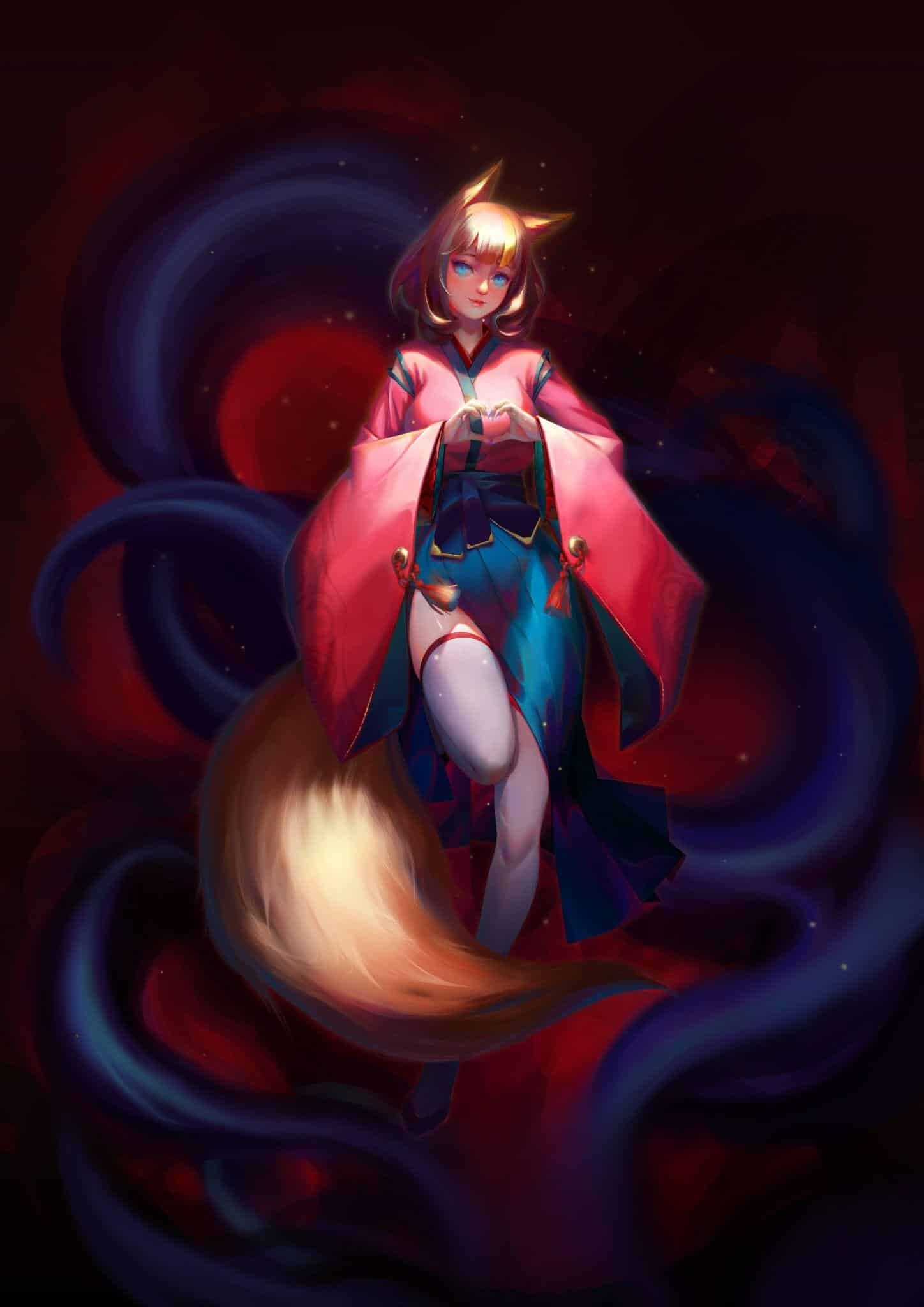
“Fox Lady” by Jing

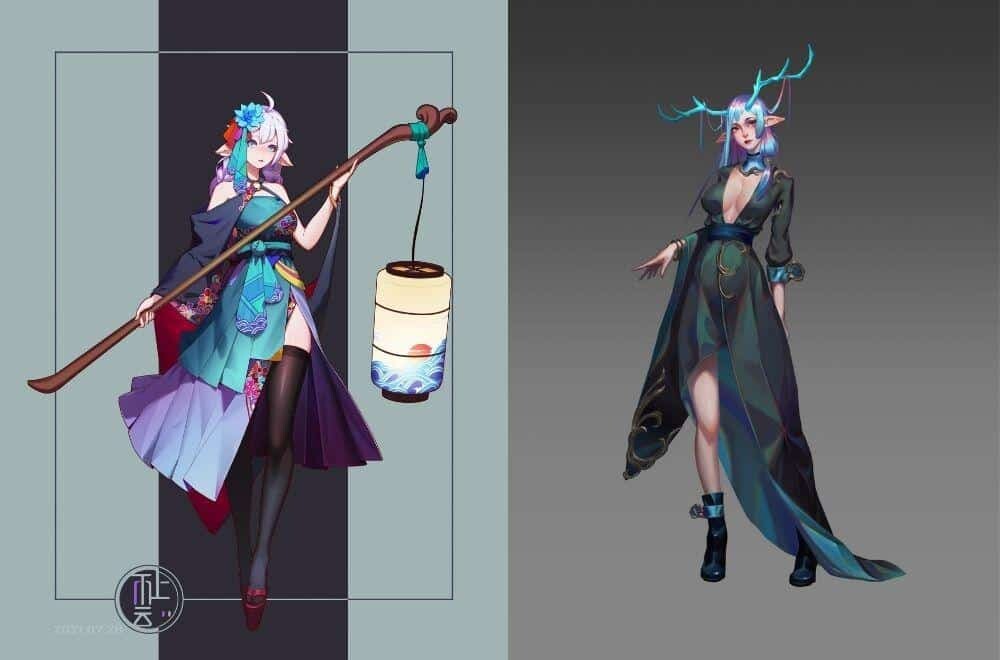
“Lantern Goblin” (left) and “Deer Nymph” (right) by Jing

Hi Jing, congratulations on winning the “Biggest Head-Turner Award” for this contest! Could you share more about how you came up with the concept behind these art pieces, and your inspiration behind them?

Jing: Thanks! A significant part of my inspiration comes from artworks such as Onmyoji and Demon Slayer, which are two of many narrative settings that drove me to create my own stories and characters. While planning my pieces for ACG Jam, I came up with an imaginary world for my characters in which humans and demons lived together.

Is there a story behind the three characters that you designed?

Jing: When I create characters, I want to invoke curiosity in my viewers to wonder about who my characters are and what their backstory is. My three characters, “Fox Lady”, “Lantern Goblin”, and “Deer Nymph” originate from the same world. I imagine them to be otherworldly creatures such as fox spirits, goblins and nymphs living on the same continent, living their own lives, with their own stories. I designed each of them with slightly different styles as I wanted to experiment and try out more art styles to figure out which I preferred.

What was your thought process when designing the characters’ style, color arrangement and fashion choice?

Jing: During the concept sketching process, I spent some time imagining their personalities, living conditions and other environmental factors. Afterwards, I collected some similar reference materials, using them to piece together the image that I want in my mind.

For example, “Fox Lady” is a character based on a kitsune, also known as a fox spirit in Japanese. In Asian folklore, fox spirits are usually depicted as mischievous, full of trickery, and have the ability to disguise themselves as attractive beings. The character I drew was thus designed to be very beautiful and eye-catching, yet mysterious at the same time. Thus, I used several dark tones in the background to create a mysterious look, and dressed my character in feminine-looking and Asian-style clothes.

How long did it take to draw all three pieces, and what were some of the tools you used to sketch them?

Jing: It took me roughly 30 hours (in multiple sittings during my free time) to create each piece, so around 90 hours in total. I mainly drew them using Photoshop.

If this project was expanded and made into something bigger with the help of other team members, what would you want to do to enhance this art piece?

Jing: I’d definitely want to spend more time on world building and developing each character’s backstory further. If I had more time, I would like to create more interesting characters as well.

GIVING ARTISTS AN AVENUE TO EXPLORE LATENT ABILITIES

At Virtuos, we are committed to creating opportunities for our game creators to continuously learn and grow in various ways, through hosting art and game jams and providing structured and on-the-job training to aid their professional development.

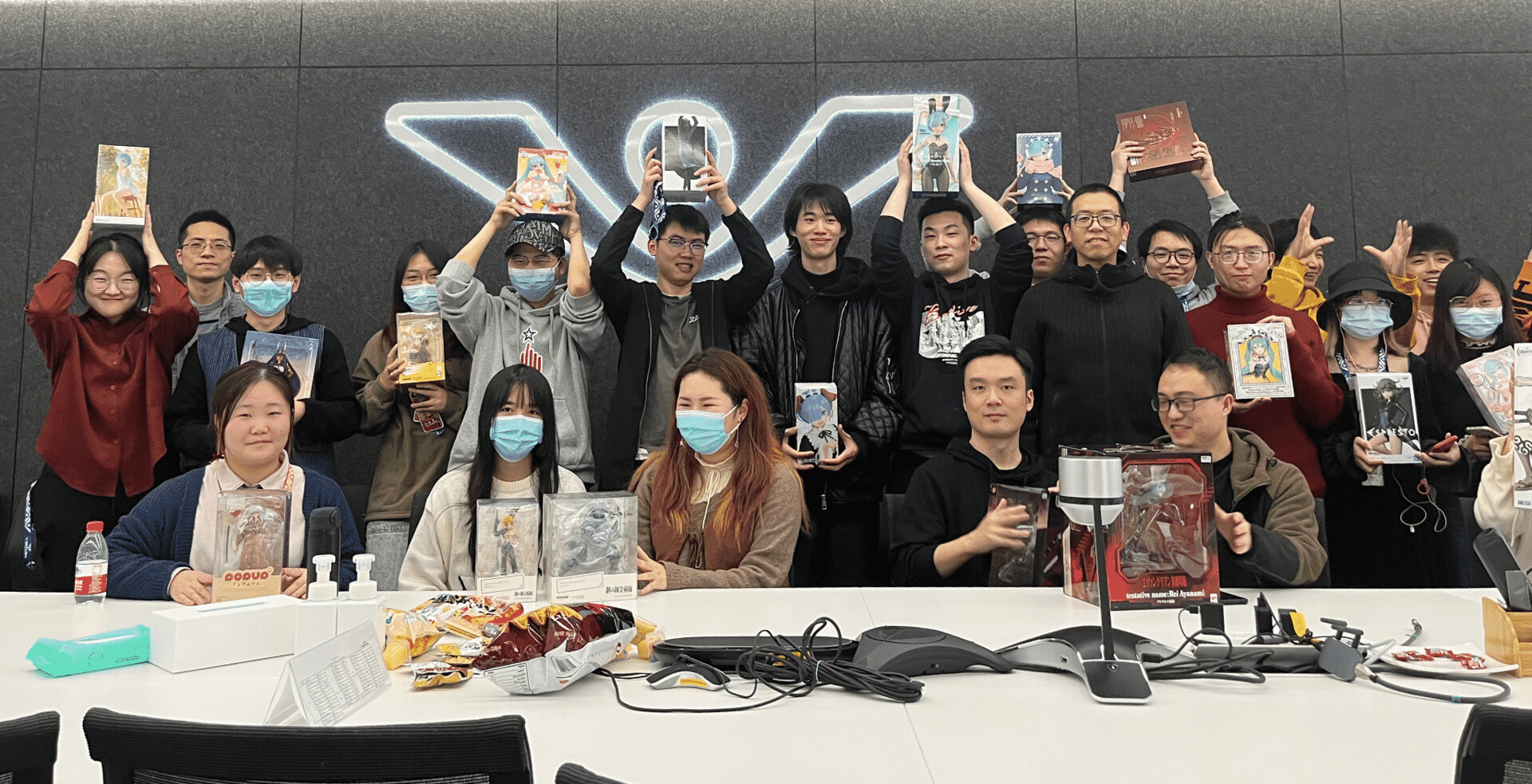
Post-contest celebration in Virtuos Chengdu

Through internal activities such as our art jams, our artists not only have the opportunity to test their own abilities but also learn from each other and encourage their fellow teammates to further hone their craft.

“Besides promoting healthy competition, the great thing about having such contests is giving our artists a platform to flex their creative muscles outside project boundaries,” said Chan, our Art Studio Director at Virtuos Chengdu. This gives our artists an avenue to unleash their latent abilities which could otherwise stay unexplored.”

EXPLORE A CAREER WITH US AT VIRTUOS

Expert Talks: How To Create And Develop A Concept Art Piece From Scratch

General / 28 April 2022

Concept art is the starting point where ideas become reality, and concept artists are responsible for the fundamental creation of a wide range of ideas, from tiny props and accessories to full characters and large environment concepts.

As concept artists, we help modelers, visual effects (VFX) teams and animators in our global studios visualize art project ideas to be developed for production,” shared Jessica Taylor, one of our artists at Virtuos Montreal.

Jessica Taylor, Concept Artist, Virtuos Montreal

WORKING AS A CONCEPT ARTIST IN VIRTUOS MONTREAL

Like many artists at Virtuos, Jessica shared that her love for drawing bloomed at a young age and has since sustained till today. As a concept artist with an academic background in graphic design and architecture, Jessica revealed that she made the switch to concept art. She wanted to find a way to combine what she learned in university and her interest to draw characters and experiment with fun ideas.

At Virtuos Montreal, Jessica works on both environment and character concept art. “It’s refreshing to work on both, as it allows me to be consistently engaged in the projects I’m working on, instead of feeling burnt out from doing strictly only one type of work. Also, it’s fun getting to work on both environment and character work and grow my skills in both aspects.” She added that the content she learned in graphic design and architecture has been very applicable to her profession as a concept artist, especially in being able to take an idea and apply it consistently throughout a design.

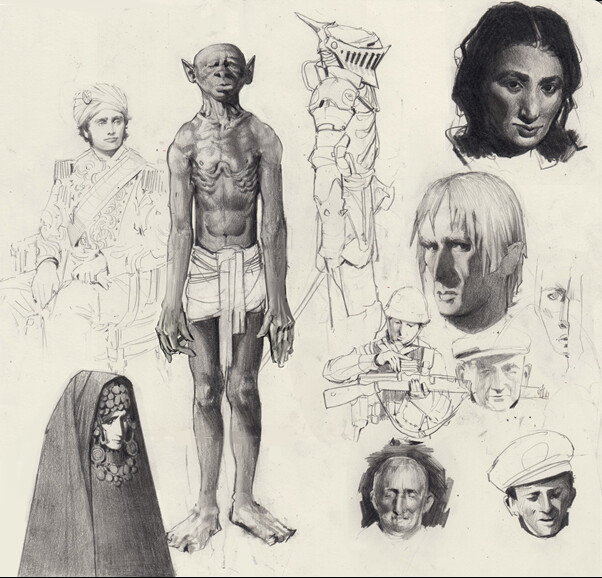
Personal Concept Art Sketches and Projects

As a concept artist, it’s important to keep an open mind and learn to appreciate different styles that other artists have.

”It’s also a good practice to draw outside of work and do some exploring on your own – just a couple of sketches a week or a few doodles here and there helps,” Jessica advised.

To improve her skills and experiment with different styles, Jessica consistently works on personal projects in her free time, some of which can be found on her ArtStation profile:

Image courtesy of Jessica Taylor

Besides sharing her sketches and projects, Jessica also occasionally uploads video tutorials for her art content on social media. Check out one of her YouTube videos here:

DRAWING A CONCEPT ART PIECE FROM SCRATCH

During our interview with Jessica, we delved into two of her personal projects on ArtStation. We learned how she came up with the ideas and developed them into complete, original creations.

1. CREATING CONCEPT ART USING REAL-LIFE REFERENCES: BRIDGE BETWEEN THE TWO ROOTS

Showing us one of her personal works, Jessica shared that the outdoors is a great place to garner ideas and inspiration for environment-themed concept art projects.

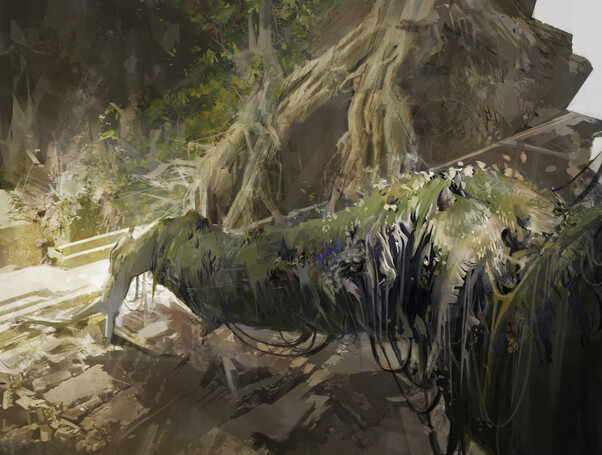
Bridge Between the Two Rocks

Jessica revealed that the piece above named “Bridge Between the Two Roots” was based on a moss-covered branch that she found just outside her house.

The branch found outside Jessica’s house

I started with reference photos that I took of the stick. I particularly liked the moss and fungi growing on the branch,” she added.

After gathering reference material, she began with a simple sketch and outlined the idea behind the piece.

Step 1: A simple sketch/outline

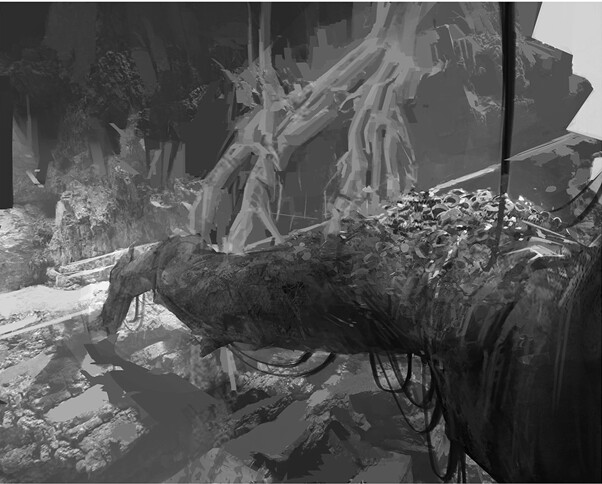
Next, she added values to the sketch to create dark and light contrasts in the details and later coloring.

Step 2: Adding values

Afterwards, Jessica overlayed the photos of the branch onto the value sketch (as shown in Step 2) and started building the details on Photoshop, creating a realistic yet mystical look.

Step 3: Building Details on Photoshop

After the initial details had been filled in, Jessica chose the color palette after preparing both a warm and cool option with eight shades each. “After adding the colors, I could really see the sketch coming together. I went with the warmer shade in the end as the cooler palette seemed a bit stale to me, so it was just a matter of personal preference,” she shared.

Step 4: Coloring

After adding the colors, she continued to add more detail and touch-ups before finally completing “Bridge Between the Two Rocks”.

Completed “Bridge Between the Two Rocks”

This particular sketch was a very fruitful exercise in creating something new by combining my ideas with real-life references,” said Jessica.

2. CREATING CONCEPT ART OUT OF A STORY: FLOATING QUARRY ISLE

Besides collecting ideas from physical environments and items, Jessica shared that she enjoys drawing ideas from fictional stories and her imagination. She experimented with creating an ethereal “floating quarry isle” in a personal challenge she set for herself.

In the concept narrative that Jessica developed, a young knight on an adventure has been tasked with a mission to forge a sword out of a special stone found on a floating quarry in the middle of the ocean to carry on with his adventure.

For the idea to work, Jessica shared that it was essential to plan and research thoroughly:

  • How would the knight be able to travel to the quarry?
  • How would he get onto the floating quarry?
  • How would he forge the sword after collecting the materials?

While researching, Jessica drew references from outdoor adventure activities such as rock climbing to enrich her ideas, adding climbing cables and suspended ladders on the floating quarries which the knight could interact with.

Research material for the floating quarry isle

Jessica started her concept sketch with a rough outline of the floating quarry isle, forming a base island with a dock for sailboats and a cluster of cuboid rocks floating above it.

Ideation and sketching

To find the ideal combination that fit the narrative of her story, she crafted multiple sketches to test and experiment with.


Concept Sketches by Jessica

After testing with multiple sketches and filling in the details, Jessica shared her final design of her floating quarry isle:

Final look of the Floating Quarry Isle

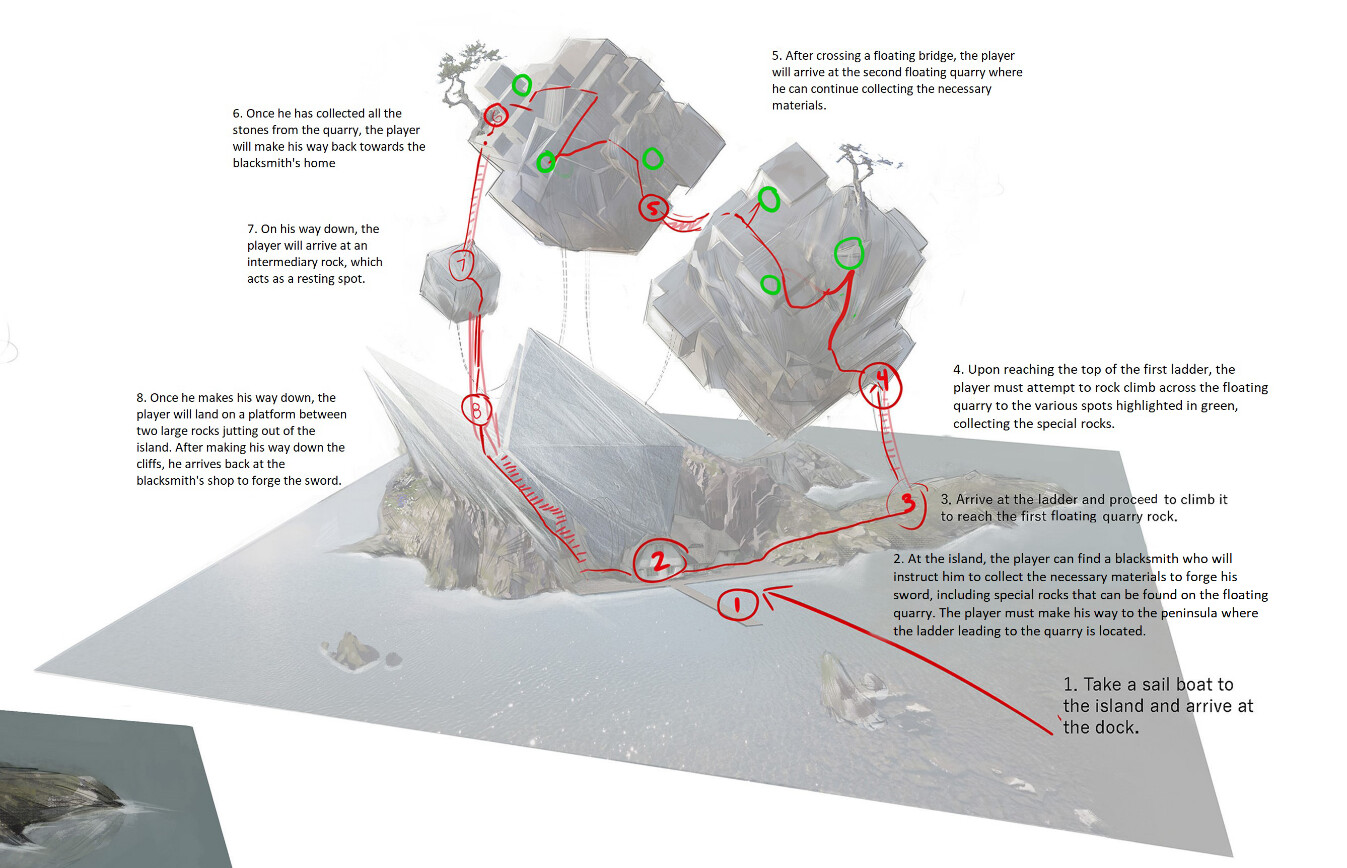
In the final design, Jessica detailed the setting and narrative of the knight’s adventure at the floating quarry isle from start to end:

  1. First, the young knight takes a sailboat and arrives at the island’s dock.
  2. The knight finds a blacksmith/stonemason living on the island. After listening to the knight’s request, he instructs the knight to make his way to the peninsula, where he will find a suspended ladder that leads to the first floating quarry where the first stone can be found.
  3. The knight embarks on his mission to collect the various stones on the floating quarries, climbing up the ladder to ascend to the first floating quarry.
  4. At the first floating quarry, the knight begins to rock climb across the tricky terrain to obtain the materials he needs.
  5. After collecting the first stone, the knight crosses a floating bridge to arrive at the second floating quarry, where he finds the rest of the materials he needs.
  6. Once he’s done collecting his stones, the knight makes his way down from the second quarry using another suspended ladder.
  7. He arrives on an intermediary floating rock on his way down, where he can take a short break.
  8. The knight then lands in a valley formed by two large, sharp stones jutting out of the island. He makes his way further down the cliffs via steps, back to the blacksmith/stonemason’s shop, where he hands in the materials to forge the sword and completes his mission successfully.

Narrative for the knight and the floating quarry isle

This project was mostly an experiment for me to try and push an idea as far as I could, and I really enjoyed the whole process. It was very satisfying rendering the final artwork,” Jessica shared.

ADVICE FOR NEW CONCEPT ARTISTS

Stressing again the importance of keeping an open mind, Jessica highlighted that taking a wide range of projects is a great way to learn and improve as a new concept artist. “Don’t limit yourself by taking on only one type of task. Trying your hand at environments or prop design projects could end up helping you design better characters, vice versa,” she said.

At Virtuos Montreal, the team regularly conducts critique sessions to toss different ideas around, Jessica mentioned, adding that such sessions enable them to pick up new tips and learn from one another. “None of the critiques is personal. We’re all trying to improve our skills and produce the best work we can, so we enjoy the process and take the comments objectively,” further sharing how the group sessions have helped her grow as an artist.

It’s a great opportunity being able to work alongside passionate artists with a variety of strengths at Virtuos Montreal. Being immersed in such an environment has allowed me to develop myself as a concept artist, especially when working with a team with an awesome attitude,” Jessica said.

If you’re looking to work in an exciting environment that encourages your personal artistic growth, Virtuos Montreal is definitely the place to be!

EXPLORE A CAREER WITH US AT VIRTUOS


Virtuos Experts Talks #11: Harnessing Photogrammetry and Creating Virtual Worlds at Sparx*-A Virtuos Studio

General / 01 September 2021

The eleventh in a series of regular articles highlighting learnings and best practices from Virtuos' global development, Art, and VFX teams.

Introduction

As PC and console hardware continues to improve, games are able to render increasingly higher poly-count meshes and higher resolution textures in game engines, thus allowing game designers to create ever more realistic environments in AAA titles. However, the process of creating these ultra-quality game assets has similarly increased in time and complexity, especially if the goal is to make them as lifelike as possible.

In hindsight, the pivot to photogrammetry is almost a logical progression, due in part to increased demand for ultra-realistic in-game assets and the continuous evolution of game engines. Now, anyone can take a series of photos, process them and produce an extremely realistic-looking model with matching textures in the span of just hours to a few days’ time, ready for use as a game asset.

Photogrammetry has been around for many years, but it wasn’t until it was publicized as a success story in the making of Star Wars Battlefront at the Game Developers Conference (GDC) four years ago, that more and more developers have begun looking into it as their next tool in their arsenal. Virtuos has similarly made progress with photogrammetry within its various studios and is currently using the technology to produce highly detailed environments in various end-to-end game production projects.

The Inception of Photogrammetry at Sparx*

A significant part of Virtuos’ photogrammetry activity is performed at Sparx* – a Virtuos studio located in Ho Chi Minh City, Vietnam. Known for its visual effects work in major blockbuster films such as Star Wars, Sparx* possesses the talent and the necessary equipment to jumpstart our exploration of photogrammetry.

Although Sparx* had been using photogrammetry for film work for quite some time, it was mainly used as an accurate guide for modelling real-world objects; the actual model was created by hand afterward, with its textures re-projected from the photos taken of its real-life counterpart.

It wasn’t until late 2018 when the studio processed and de-lit data and then rebuilt entire locations in Unreal for the first time for Disney Plus’s “The Mandalorian”, that photogrammetry was seriously considered as a tool for creating realistic 3D objects efficiently. The years that followed saw Sparx* devote more time and resources to researching and testing the technology, simultaneously building up the process and acquiring the necessary hardware. At this moment, Sparx* is already using photogrammetry extensively on a number of yet-to-be-released game projects. Leading the charge are Kristian Pedlow, Senior Art Director, and Minh Son, Senior Technical Artist. They are members of the ‘Photogrammetry Strike Team’ at Sparx*, a team of staff responsible for all things photogrammetry within the studio.

Capturing Reality: How Sparx* Acquires Scans

Before heading out into the world to conduct photogrammetry scans, the Sparx* Photogrammetry Strike Team first assembles a collection of equipment necessary for the acquisition process:

  • A full-frame body camera (the team currently favors a Sony A7II)
  • A decent full-frame prime lens and zoom lens (28-70mm zoom lens are the present choice)
  • An X-rite Color Checker
  • A ring flashlight, to ensure the subject is properly lit
  • Light diffusers (to avoid the need to delight hotspots in photographs)
  • A foliage cutter
  • Flags to pin on objects when scouting and or Google Maps
  • Slates and a ruler for naming objects and scale cue
  • A handheld flashlight (for foliage)
  • Two orbs – in chrome and grey
  • Black-colored cloth for use when keying out objects (black works better than green or blue)

Minh Son: “A typical expedition will last from a few days to a week, depending on how large the landscape is and how many assets we want to acquire in the chosen biome.

We usually begin by spending up to a full day to scout the area that we chose, during which we would make a list of all the assets that we would need. Then we’ll spend the next few days systematically capturing all of them, making sure that we don’t miss out on anything.

Before the acquisition of each asset, whether indoors or outdoors, we would first take a photo of it with a Color Checker for white balance and color correction later. Another photo would then be taken with a rule to get an idea of the asset’s scale.”

Once the preliminary photos are taken, the capture can begin proper. There are three main categories of scans to capture in these expeditions: Assets, Surfaces, and Foliage/Atlas.

Assets

In the context of photogrammetry, Assets are real-world objects that are scanned and processed individually.

First, the Strike Team captures an overall view of the asset, to make sure that no part is missing when they proceed with image alignment, and to minimize the need for manual alignment. Next, the camera is moved up close against the asset to capture every single detail possible; a third-round may be required if the asset possesses some sharp corners that need focusing on.


Minh Son: “In cases where hard shadows appear like in the above example, we would try to capture with a polarization filter which may help in reducing the directional light intensity somewhat, although a delighting phase is still necessary later on in the process.

For proper capturing, we make sure to always move the camera between images. Panning or rotating the camera on a stationary tripod without moving it will sometimes cause duplicate geometry with a slight offset. I would also recommend avoiding camera groupings like the ones below:"

Surfaces

Environment surfaces are also acquired via photogrammetry when there’s a need to capture the surrounding landscape.

For surface acquisition, the team uses a tripod or monopod to attach the camera, ensuring that the camera is always perpendicular with the surface, as in the image below.

Minh Son: “We are also testing acquisition with a prime lens since the quality of its output is better than a zoom lens. In this example, we’re using a Sigma 50mm f/1.4 EX DG HSM to capture the surface.

Aside from that, we also capture another overview image using a wide-zoom lens. This is not only for scaling purposes, but also to generate a PBR material based on a single image – if needed – by using Substance Alchemist or Unity Art Engine. The example below shows a processed image captured using a Sigma 12-24mm f/4.5-5.6 EX DG HSM.”


Foliage/Atlas

Foliage atlas captures are frequently done to provide accurate scans of plants without too much storage overhead.

Previously, the team would use a cutter to trim a few branches and twigs, storing it in zip lock bags and bringing the samples back to the studio for further acquisition. But they soon realized that it was much more efficient to perform the acquisition onsite whenever possible, by putting the atlas on top of a blue screen and using a handheld light to illuminate it from 8 angles.

While this has worked fine so far, the team is considering switching the blue screen with a simple grey tarp instead, which may be a better choice due to the fact that objects on the blue screen might receive a blue cast that could be difficult to remove.

Minh Son: “Lighting conditions are our main obstacle during the acquisition process. Overcast cloudy days are ideal for photogrammetry, but because of the weather in Vietnam, we mostly find ourselves shooting on sunny days. This means we have to deal with hard shadows and over-exposure lighting, especially in the forest when there are areas covered by trees – sometimes we find ourselves capturing assets in shady areas with some brightly lit spots in between.

To deal with this, we try to illuminate the area with our ring flashlight, and also capture everything in RAW image format so that we can deal with shadows and highlights in Photoshop / Lightroom during processing.”

Bringing It Together: Processing the Scans

Once the team returns from a shoot, the data will need to be cataloged and processed in the studio, turning the acquisitions into 3D objects ready to use in-game engines like Unity and Unreal.

Kristian: “During processing, it is possible to find that some acquisitions will have details that were out of focus or in shadow, making them unusable. To try and counter this, we do as much processing as possible on site: we capture an asset, swap out our cameras SD cards, and do a quick image align on a laptop that can do the processing on the spot. This way, we can ensure a high-quality capture and eliminate the need to return to the same location the following day.”

Minh Son: “For processing images, we currently use Photoshop to color correct, then run it through Reality Capture (RC) to rebuild the mesh. After the processing, sometimes we were able to simply cut out the mesh, reduce the polycount in RC then export the low poly and high poly for map baking. For some cases, we would import it into ZBrush for more touch-ups, like filling out the holes on an object or slicing it into modular pieces.

The process of baking maps usually happens in Substance Designer/Painter and xNormal since these software programs, especially Substance Painter and xNormal, can handle up to more than 200m of tris meshes.

After the baking process, we would then run the base color texture through a de-lighting process, which removes the shadows and highlights in textures. Based on the assets being worked on, we would use either the Unity De-Lighting tool or Agisoft De-Lighter.

At this point, the assets would be stored in a domestic asset library for future use.”

The Future of Photogrammetry at Sparx* and Virtuos

The Photogrammetry Strike Team is – for now – in its nascent stages of establishment. The team itself is mainly comprised of senior environment artists who already have experience with projects that require photogrammetry and possess the know-how to go out and capture scans that their clients would ask for.

In time to come, the team has plans to flesh out its roster, training up more people in the process, and install team leads to take charge of the entire process. The end state of the Strike Team would include artists dedicated to photogrammetry as a discipline.

Meanwhile, Sparx* continues to improve on its range of photogrammetry services. While using photogrammetry to augment its own asset creation capabilities was the main catalyst for the studio’s adoption of the technique, Sparx* has begun offering our clients the ability to pick specific biomes and assets to replicate via photogrammetry. For now, only environments native to Vietnam are available due to restrictions imposed by the COVID-19 pandemic, but ideally, the team is fully capable to travel to nearby countries to access a wider range of source material.

This, combined with the studio’s continuous efforts to upgrade both its manpower and quality of equipment, indicates aggressive incorporation of photogrammetry as part of Virtuos’ array of End-to-End game development services.

About Virtuos

Founded in 2004, Virtuos is a leading video game development company with a headquarters in Singapore and studios in Asia, Europe, and North America. With over 2,000 full-time professionals, Virtuos specializes in game development and 3D art production for AAA consoles, PC, and mobile titles, enabling its partners to generate additional revenue and achieve operational efficiency.

For over a decade, Virtuos has successfully delivered high-quality content for more than 1,300 projects and its clients include 18 of the top 20 digital entertainment companies worldwide. More information at www.virtuosgames.com

Rise of Tomb Raider

General / 03 June 2020

What tool was used for these? Maya, ZBrush, Xnormal, substance painter, MD, Marmoset.


Were there any challenges and what were they? 

The game itself features major elements of ancient Mayan culture, such as unique totems and motifs. This was an entirely new subject matter for us that required lots of research to gather sufficient knowledge in.

We had to revise our pipeline and methods to remain on track for our goal, which was to achieve high quality visual effects for this title.


What was the objective? 

We wanted to ensure that the visual effects were as realistic and convincing as possible, so that the players would be able to immerse themselves in an accurate portrayal of local life at that time period.

How was the texture realistically achieved? Was there a technique employed by Virtuos? 

The tools and methods used for the production of this title did not differ too much from other projects; the key was in analyzing and understanding the main requirements of the game.

For example, when we were dealing with assets in the project, we had to seek out references from still photos and film that we could rely on for this process. It was also imperative that we understood the living conditions as well as the technological level of the culture in that specific era in order to replicate minute details, like the materials used in everyday tools, the aesthetic designs of braids and other such ornaments.

To create the heads and facial features for characters found in the game, we referred to real examples based on the indigenous peoples of India and South America. Among other things, we learned that the depth in the skin tones can be an indicator of the level of exposure to sunlight, and can also suggest a history of physical labor and past living conditions.

Virtuos Experts Talks #4: Excelling at 2D and 3D Animation for Games, TV and Movies Takes Natural Talent, A Myriad of Skills and Superb Training

General / 13 September 2018

The fourth in a series of regular articles highlighting learnings and best practice from Virtuos’ global development, Art and VFX teams.

In this instalment, Head of Animation at Sparx* Studio - Patrice Compagnon, goes in-depth on how success has come from great learning - planned and un-planned.

Sparx* Vietnamese studio has worked on some amazing, high profile projects in its 23-year existence, with a focus on top-grossing movies, including a few Star Wars blockbusters; TV series such as Star Wars Rebels and games including Fallout & Battlefield. Success does not come easy, but hard work, finding a unique talent base, and intense training have been the keys to recent successes!

So what’s Sparx* secret… Starting with the fundamentals - whether it is 2D or 3D, good animation relies on a combination of skills.

First, and maybe most important, is to have a comprehensive knowledge of human anatomy, movement, limits of joints, how muscles work, weight, body mechanics, rhythm, spacing, staging, composition, emotions and even acting skills!  It is also important to understand all types of locomotion, and specifically how two and four-legged animals move... even how birds fly… It is an art.

The beauty of true animation is that nothing is frozen solid. There are 12 principles of animation, and it is important that animators keep on learning until they are confident enough to decide specifically when to apply them and when not to.

Observational Expertise

Being an animator means being able to constantly evolve while keeping true to animation grassroots. In order to do that, animators need to feed themselves with a constant thirst for curiosity & observation. At the coffee shop, at the mall, etc. An animator might stare at some random stranger for minutes just to learn an interesting pose for his next project. They might leave the cinema room full of children and parents with questions like: Why this specific acting style for this movie? Why did that action look so impressive? Was that a good facial expression in that scene?

Sparx* is widely considered as the best learning & development environment for animators in Vietnam.

“Quality, quality, quality” was the mission statement that so many animators grew up hearing… and if we’re honest, in the West, Asian animators suffered for a long time from a low reputation of quality, without any real justification. Part of the reason was the high quotas & low budgets, and that cliché used to be a huge barrier. The mission at Sparx* was to make supreme efforts to bring the animation quality to new heights with a couple of key objectives, to invest in localized training and to instil a certain attitude amongst animation teams, almost like an “infinity-and-beyond” learning culture. It worked, and quality, enthusiasm and success quickly followed – the bar was set high, though.

The Highest Possible Benchmarks

It was agreed, as a company that just ‘reasonable’ quality was not enough. It is important that people, customers, clients, are in awe when they realize that a project has been completed by talented, passionate Vietnamese animators. From day one, benchmarks were set very high, with powerhouses like Pixar, Disney, DreamWorks, Blue Sky and Sony Pictures Animation the target.

A library of high-quality benchmark images and movies range from 2D traditional, 2D digital, cut-out, stop-motion to 3D Animation work was added to, every week. It helped Sparx* tailor classic animation books, documents & tutorials and localize them into in-house training materials, from which animators study and analyze the work, styles - learning every day.

Classically the philosophy of ‘learning by doing’ was adopted, as each project always taught so many points – from an animation style, composition, staging direction, storytelling, character design & performance, to production process & team management. As each project was completed, case studies, key learning & points to improve on were documented – valuable knowledge that should not be wasted.

Customizing training methods so as to fit the local culture is one of the studio’s keys to success

In addition, numerous internal activities including masterclasses delivered by international experts, competitions and workshops about different topics from design analysis, pose analysis, staging, 3D tips and tricks, etc. were arranged. Also, collaborations with universities & training centers in Vietnam delivered workshops that triggered curiosity and interest in young talent and have been hugely successful.

Understanding the collective mindset found in most Asian cultures, one of the keys was to create a natural group bond, having trainees helping each other the same way animators do. By always pushing and insisting on common objectives it is easier to build a strong cohesive spirit that will last for years. Animation is a team effort, and the success of a project defines the success of the whole team. Equally, the success of training is the success of all trainees.

That belief creates such an amazing sense of belonging and common destiny, helping overcome challenges & turmoil, especially during production. There are always difficult projects, but success at the end comes from the unity, cohesion and the camaraderie that bond the animators together.

Training Pays Dividends

Sparx* has started to reap the rewards of the super training -  as the very first group of trainees brought in 12 years ago are now Animation Directors, Lead Animators, Senior animators and Technical Lead animators. They are now in charge of training the next generations of animation trainees and junior animators; a virtuous circle is in place!

Teaching had huge benefits for the trainers too: clarifying thoughts and needs of the organization, and being put in the shoes of a trainee helps answer 100s of questions:

  • Where to start (software, tips and tricks or animation techniques, etc.)?
  • How to train people about the process and its importance?
  • Which methodology to apply?
  • And, last but not least, how to inspire people and grow the passion for animation in them?

The crazy pace of this industry, on the other hand, puts pressure on the need to keep updating and improving training techniques and materials. It is fair to say that, trainers, learn at the same time as trainees and junior animators do.

It is fair to say that, trainers, learn at the same time as trainees and junior animators do.

All the daily efforts in developing people and keeping them passionate have helped maintain high-quality animation, with success from shows like the award-winning TV Series: Star Wars Rebels. Animation TV making it so worthwhile. And really it is the guidance and support of partners, like the Lucasfilm Animation team, that pushes the team’s limits, ensuring adaptation to the latest style, push quality even higher - season after season.

About Virtuos

Founded in 2004, Virtuos Holdings Pte. Ltd. is a leading videogame content production company with operations in Singapore, China, Vietnam, Canada, France, Japan, Ireland and the United States. With 1,500 full-time professionals, Virtuos specializes in game development and 3D art production for AAA consoles, PC and mobile titles, enabling its customers to generate additional revenue and achieve operational efficiency. For over a decade, Virtuos has successfully delivered high-quality content for over 1,100 projects and its customers include 18 of the top 20 digital entertainment companies worldwide. For more information, please visit www.virtuosgames.com.

About Sparx* - A Virtuos Studio

Sparx* is a Vietnamese production studio that offers a superb range of end-to-end solutions for highest-quality Animation, Cinematic, and Game Development. Acquired by Virtuos—one of the world's largest digital content providers—in 2011, Sparx* has over 400 professionals ready to be fully integrated into various pipelines of many major publishers. For more information, please visit www.sparx.com.

About Patrice Compagnon

Serving as Senior Animation Director at Sparx*, our studio in Vietnam.

Passionate with Animation, Graphic Arts and Comics, Patrice Compagnon has over 20 years’ experience in Animation with a strong artistic background. Since 2002, he has supervised animation & layout crews overseas at Sparx* and trained Lead animators, animators, technical animators and Layout men. He strongly believes and works on in-house tailored training sessions for knowledge transmission.

Virtuos Experts Talks #3: Nintendo’s Successful Switch Platform Provides Opportunity for Developers, and Offers an Install Base of Close to 20 Million

General / 23 August 2018

The third in a series of regular articles highlighting learnings and best practice from Virtuos’ global development, Art and VFX teams.

The team at Virtuos has been making a name for itself over the past few years by both developing original content and remastering existing content for the Nintendo Switch platform. The company has worked on LA NOIRE, with RockStar Games, DARK SOULS with Namco, and of course, STARLINK with Ubisoft. Virtuos has already shown themselves as one of the premier developers working to bring amazing titles such as these to the Switch, with more soon to come.

From a developer’s point of view, many people are stating that the Switch is Nintendo’s easiest platform to build games for, ever!

This is based on the whole idea that the Switch does not just offer one singular console experience but a whole range of multi-platform features. As we know, it can be placed in a dock to link to a TV or be removed from the dock and played as a handheld by utilizing the two detachable Joy-Con controllers, perfect for multi-player sessions at home or on the go.

Many developers were expecting major headaches as they sought to get their games optimized for large TV screens and handhelds alike – but many have credited Nintendo with almost eliminating hours of tedious fine-tuning. It’s not quite automated, but it’s not a factor that limits multi-screen success.

Adaptive resolution in different usage scenarios of 'Starlink: Battle for Atlas'

Jonathan Boldiga, Senior Technical Director at Virtuos, digs even deeper to share some superb tips on working with the platform.

First and foremost, it’s becoming clear that developing on Switch is getting easier and easier. With such a solid toolchain, easy to understand (and extensive) documentation, and great support staff, it’s rare to come across any real roadblocks thanks in large part to their fantastic dev support.

The handheld screen offers 720p resolution, the screen is bright and its colors are vibrant. When plugged into the TV, it hits 1080p. To optimize performance, a few key observations will help developers maximize GPU potential. This includes using texture compression and reducing texture sizes to improve performance and reduce the memory footprint.

Vertex processing can also get expensive so mesh geometry should be reduced.  There are many great middleware tools such as Simplygon and InstaLOD that do geometry optimization very well.

If a developer’s rendering pipeline uses deferred rendering, reducing the number of render targets in the GBuffer can help with performance by reducing bandwidth usage.  Virtuos achieved good results, using only two render targets for its GBuffer layout however this may require some rendering feature tradeoffs.

Getting deeper into the nuts and bolts - as with all modern consoles, the Switch CPU has a multicore configuration which requires games to be multithreaded in order to get the most out of the hardware.  Engine’s that are predominantly single-threaded can pose some optimization challenges。

In Virtuos’ work on Starlink and L.A. Noire, success was derived from the following threading model:

  • Main Thread (1) – Dispatches work to different job threads.
  • Render Thread (1) – Submits rendering commands.
  • Short Jobs Thread (2) – Jobs that need to be done in one frame
  • Long Jobs Thread (2) – Jobs that can be done over multiple frames

Utilizing a depth pre-pass may be beneficial depending on your pipeline setup.  Virtuos found big gains using it on some titles and less so with others.  It’s recommended to at least give it a try, as it can be implemented rather quickly in most engines. 

It’s also recommended that adaptive resolution is adopted as it is very useful for maintaining a constant framerate when the GPU is overloaded.  Experimenting with different resolution “floors” for handheld mode versus TV mode is critical to finding what works best with each specific game.

For streaming, loading, and other I/O operations, a good compression scheme is extremely useful and cannot be overstated.  This is useful for reducing data size so it can fit on smaller cartridges as well as improve streaming performance.  On recent projects, LZ4 was the go-to compression method with a decent compression to decompression ratio.  

Experimenting with commercial middleware solutions can often produce better results than LZ4 but the titles in question didn’t really need the additional compression or decompression performance. Testing LZ4, zlib, zstd, and commercial middleware offerings are highly recommended, as results may vary from title to title.

As a conclusion to this overview, there have been a few areas that need to be looked at and topics that the Virtuos team has highlighted about the platform that may be relevant to other developers.

  • When using deferred rendering, Virtuos is finding it’s important to have a compact GBuffer to reduce bandwidth.
  • Compared to other platforms, overall the GPU is weaker, the CPU has fewer cores, and obviously, it has docked and undocked modes. None of this impacted the success (to date) working with Ubisoft.
  • CPU optimization can be challenging due to the limited number of cores. 
  • Certain effects and materials need to have custom optimized paths specifically for Switch.
  • While seeming counter-intuitive, hitting framerate targets is actually easier in handheld mode.  This is because the docked mode has much larger resolution targets.
  • Moving forwards, it’s certainly worth looking into non-deferred rendering models on the platform to see if they might have better performance. Potentially, this could be either traditional forward or forward+ rendering.
L.A. Noire docked and undocked gameplay test

Overall, the Virtuos team has had a lot of enjoyment working on the Switch and sees many new opportunities for existing IP to come across to the platform. In the coming months, the company hopes to unveil new projects that take advantage of everything the Switch has to offer.

About Virtuos

Founded in 2004, Virtuos Holdings Pte. Ltd. is a leading videogame content production company with operations in Singapore, Canada, China, France, Ireland, Japan, Korea, the United States, and Vietnam. With 1,600 full-time professionals, Virtuos specializes in game development and 3D art production for AAA consoles, PC and mobile titles, enabling its customers to generate additional revenue and achieve operational efficiency. For over a decade, Virtuos has successfully delivered high-quality content for more than 1,300 projects and its customers include 18 of the top 20 digital entertainment companies worldwide. For more information, please visit www.virtuosgames.com.

About Jonathan Boldiga

Serving as Senior Advanced Technical Director at Virtuos Games, Shanghai.

Jonathan is a seasoned technical director with a demonstrated history of AAA game development. In addition to his solid technical background, over the years Jonathan has directly managed large engineer teams and has accumulated rich HR management, project and business management experience.